




kindergarten teacher

Expert in early childhood education to help children acquire lifestyle habits in a group setting. A popular profession even in a society with a declining birthrate!
Perfect For …
Must be physically fit and love children. Must be able to think creatively from the children's point of view. Must be able to treat children with love and respect.
Job Details
Teach the basics to children from 3 years old to elementary school age.
Kindergarten teachers are professionals who educate young children in kindergartens. They work with young children from the age of three until they enter elementary school, nurturing their abilities and habits in such areas as health, relationships, environment, expression, and language. It is also important for them to acquire proper lifestyle habits in a group environment. It is expected to bring out the various potentials of children through play and exercise.
Key Points !
Licensure required.
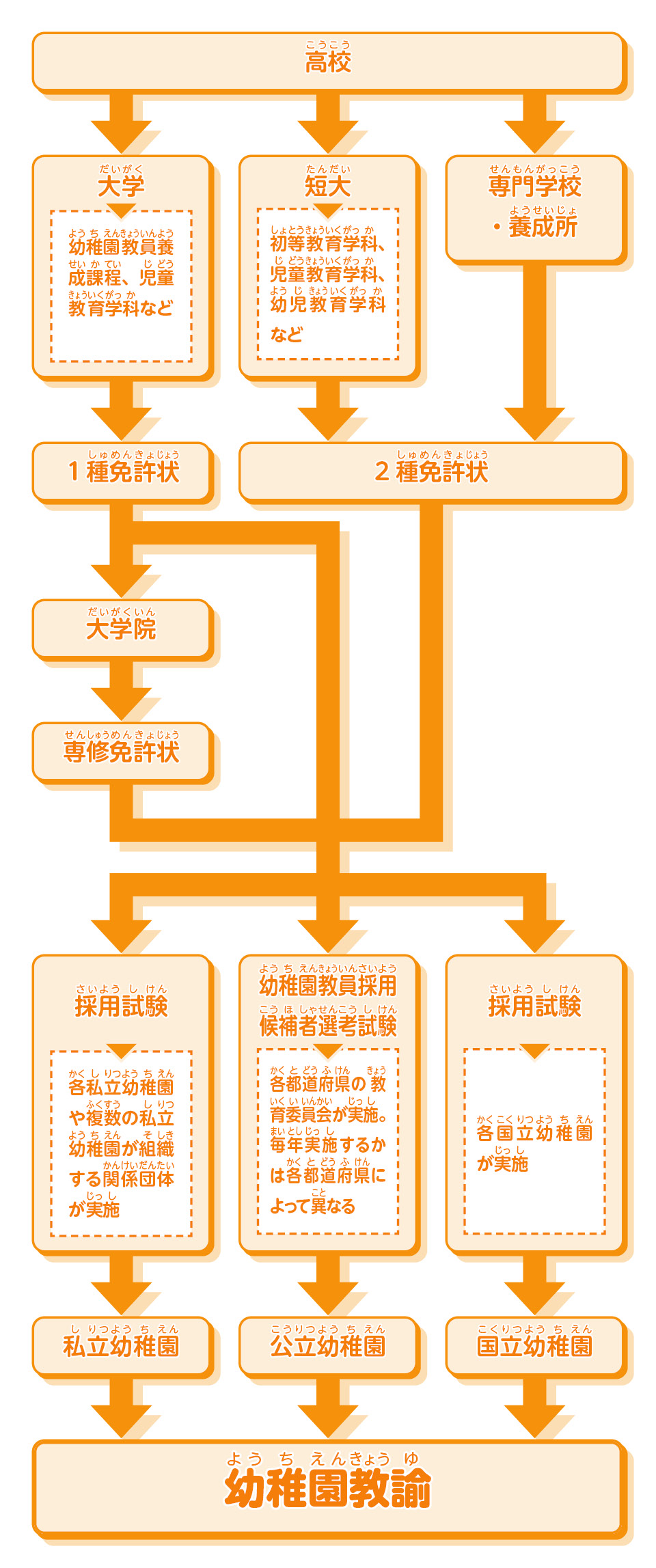
First, a kindergarten teacher's license must be obtained, and then the teacher must pass an employment examination. To obtain a license, students must take the required courses stipulated by the Licensure Law at a university, junior college, or vocational school accredited by the Minister of Education, Culture, Sports, Science and Technology. There are three types of licenses: Specialized, Type 1, and Type 2. While there are differences in starting salary and other factors, the job description is the same. In addition, teaching licenses are valid for 10 years, so those who wish to continue working must take a license renewal course of at least 30 hours.
Public and private hiring methods differ.
The recruitment examinations differ between public and private kindergartens. For public kindergartens, local boards of education conduct recruitment examinations, just as they do for elementary, junior high, and high school teachers, and the first and second rounds of examinations are conducted to determine employment. For private kindergartens, universities, junior colleges, and vocational schools recruit, and each kindergarten conducts its own selection process to decide who to hire.
In the Future
Qualified nursery teacher would be an advantage.
The need for cooperation between nursery schools and kindergartens is increasing, and the number of "certified child care centers" that offer both "child care" and "education" functions continues to grow. To work here, one must be qualified as both a kindergarten teacher and a nursery teacher. Since the number of kindergartners is at a standstill due to the declining birthrate, it is likely that employment opportunities will widen if you also have a qualification as a nursery teacher.
Job Facts
Income.
In the case of public schools, it is based on the salary scale for educational positions (e.g., elementary, middle, and high school) as defined by the School Education Law. In the case of private schools, it is determined by individual contracts between the school and the teacher. In the case of public schools, there is no salary disparity between men and women and bonuses are not affected by the economy since they are public employees. The average annual salary of kindergarten teachers, both public and private, is approximately 3.8 million yen (average age: 36.3 years old).
Vacation?
Basically, most kindergartens are closed on Saturdays, Sundays, and holidays. If a holiday falls on a school event, a substitute day off may be taken on a weekday. During summer and winter vacations and other periods when the kindergartens are closed, teachers have to go to work as they have various jobs, but many of them take paid vacations during these periods when children are not present.
Where do you work?
Public or private kindergartens.
Your Future Path
It's a chart that shows at a glance the main routes to getting a job as a kindergarten teacher!