




curator (e.g. museum)

They collect, store, display and study materials in museums, art galleries, zoos and aquariums. It is a profession that requires considerable knowledge and experience.
Perfect For …
A person with an inquisitive mind. People who are easily moved. A person who is very patient. People who like to talk with others.
Job Details
Professional staff working in museums, etc.
They collect and store valuable materials and other items, exhibit actual items and specimens, and conduct surveys and research. In addition, they promote exhibitions, prepare catalogs and explanatory texts, provide advice and guidance to visitors, and manage all administrative work and money. In order to work as a curator at a museum, one must have a national qualification as a curator.
Key Points !
Qualify as a curator at a college or university.
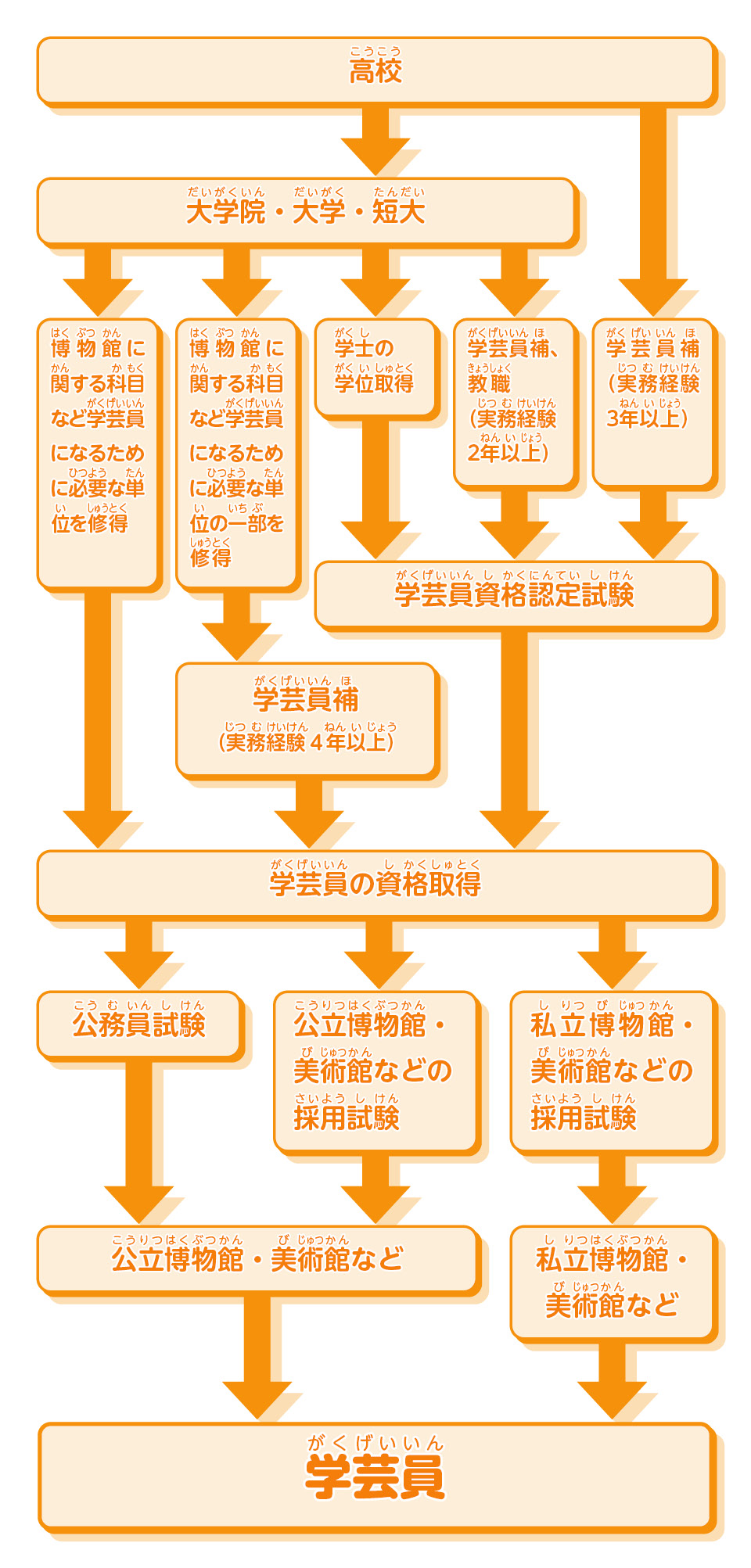
A university graduate who has completed "museum-related subjects" is eligible to become a curator. Alternatively, a junior college graduate who has earned at least the prescribed number of credits, including "museum-related subjects," and who has worked for at least three years as an assistant curator, librarian, or teacher to support the work of a curator, may obtain a curator's license.
Pass the certification exam
The certification can be obtained by passing an examination administered by the Ministry of Education, Culture, Sports, Science and Technology (MEXT). There are two types of examinations: examination certification and no-examination certification. In the examination certification, the applicant must pass six subjects. In the no-examination certification, on the other hand, the Minister of Education, Culture, Sports, Science and Technology determines whether the applicant passes or fails the examination based on actual work experience (academic knowledge and performance) and other factors. The requirements for the examination are high, including those who have graduated from a graduate school with a master's, doctoral, or professional degree, and those who have worked as an assistant curator for 10 years or more and have received an endorsement from the prefectural board of education.
In the Future
With the increase in museum-like facilities, there will be more opportunities to play an active role
There are more than 1,000 museums nationwide, including archives and other facilities, but many museums are not recruiting all the time due to deteriorating local government finances and other factors. However, the number of facilities that do not meet the requirements for museums recognized by the government but that offer similar programs to those of museums (museum-like facilities) is increasing every year, so the number of opportunities for curators to play an active role will also increase.
Review of the curatorial system
A curator is similar to a "curator" at a museum or library in the U.S. or Europe, but the actual work performed by a curator is slightly different. While "curators" use their academic expertise to collect, research, and study artworks, Japanese curators are often involved in miscellaneous tasks related to the operation of museums and other institutions, and have limited opportunities to apply their specialized knowledge. Currently, the "Museum Law" is under review, and it is hoped that the position of curators will be improved. At the same time, the quality of curators will also have to be improved.
Job Facts
Income.
Curators at public museums and art galleries are local civil servants in general administrative positions. Salaries vary by prefecture, but the national average salary is approximately 344,000 yen per month (including support allowance and regional allowances). In the case of private museums, the salary is in accordance with the rules and regulations of the operating organization.
Vacation?
Shift nature with one or two days off per week. Most museums are open on weekends and holidays. You will have to take a day off during the week.
Where do you work?
Museums, art museums, archives, zoos, aquariums, botanical gardens, archives, etc.
Your Future Path
It's a chart that shows at a glance the main routes to getting a job as a curator!