




scientist

A scholar specializing in the study of science.
Perfect For …
People who have a strong curiosity to know and try something. People who are very devoted to what they are interested in. A person who can think calmly.
Job Details
Specialize mainly in natural sciences in laboratories, etc.
They work at universities or private research institutes and conduct research mainly in the natural sciences (physics, chemistry, biology, astronomy, etc.). The research is summarized in papers and presented at conferences and in academic journals. The results of their research lead to the development of unprecedented products, ideas for the global environment, keys to solving the mysteries of the universe, and other areas that will change society. It is scientists who continue their research for a better future for mankind.
Key Points !
Studied natural sciences at university and earned a Ph.
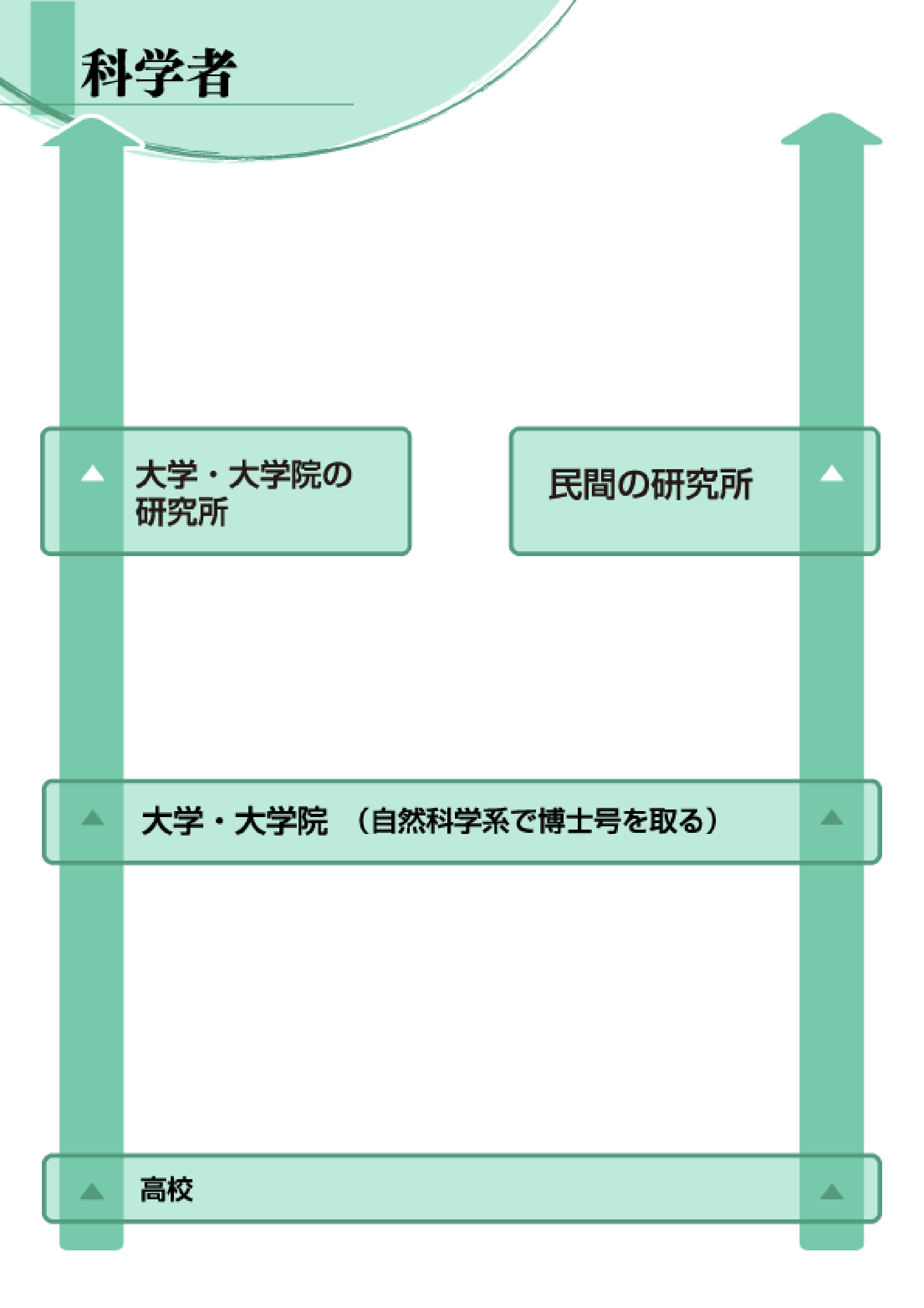
To become a scientist, you need to study natural science in a university science and engineering department and earn a doctorate degree in graduate school. First, study hard in science and math courses for college and read many books on natural science. Scientists also need to be proficient in English. This is because papers are written in English, the lingua franca, so that scientists around the world can read them. If your papers are highly evaluated, you can work as a scientist at a university or private research institute in your field.
University" or "private company" if you want to continue your research
The workplaces where scientists work are mainly universities and private research institutes. Once hired as university employees, they work their way up through the ranks to assistant, lecturer, assistant professor, associate professor, and then to professor as they continue their research. However, the number of positions is limited, so if there are no vacancies, the employee will remain an assistant for a long time with no increase in income. They can also look for vacancies at other universities. On the other hand, at a private research institute, the key point is whether or not the research leads to profits for the company. If the research matches the company's objectives, a high income can be expected.
In the Future
Japan, a Nation of Science and Technology, Again!
In resource-poor Japan, the wisdom of its outstanding scientists has become a national asset, and the country has established itself as a "science and technology powerhouse. In recent years, however, scientists have been leaving Japan for Europe, the U.S., China, and other countries with abundant research funds and environments, and there is an urgent need to revitalize Japan as a nation of science and technology. The government and the private sector are now working together to invest in human resource development and research facilities, and the number of workplaces in Japan that are conducive to learning and working for aspiring scientists is expected to increase.
Job Facts
Income.
If you are doing research and writing papers while working as a lecturer or the like at a university, your monthly income starts at around 200,000 yen. In the case of a private research institute, monthly income also starts at around 220,000 yen.
Vacation?
The basic rule for both universities and private companies is two days off a week. Some research cannot be interrupted, and the amount of time off depends on the nature of the research.
Where do you work?
Universities, graduate schools, and private research institutes.
Your Future Path
It's a chart that shows at a glance the main routes to getting a job as a scientist!