




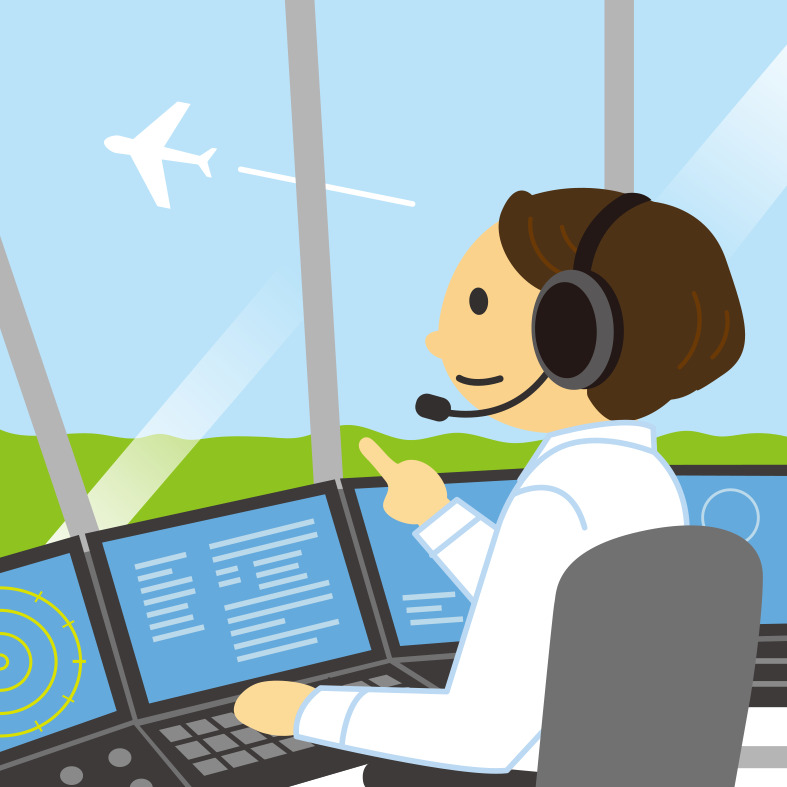
They watch over aircraft in flight and direct the order of takeoffs and landings to prevent congestion at the airport.
Perfect For …
Since this work involves human lives, it requires a sense of responsibility and the calmness to make calm decisions at any time. Since many people are involved in air traffic control, cooperation is also essential.
Job Details
Use your eyes and radar to the fullest to keep the skies safe.
They instruct pilots via radio on the height, distance, and direction of flight, as well as the order of takeoff and landing, so that aircraft can operate safely from takeoff to landing. The work of air traffic controllers can be divided into three categories depending on where they work and what they are in charge of. The first is "airfield control," in which air traffic controllers check aircraft in the control tower at the airport, where they can see everything around them, and give permission for takeoffs and landings, as well as instructions on the direction in which to fly. The second is radar control. The second is radar control, which uses radar in the airport's radar control room to detect aircraft and instruct them on the order of takeoff and landing, the direction and height of ascent and descent, etc. The airspace in charge of this function is approximately 9 km from the airport. The third is "airway control. The third is "airway control," which uses radar to detect aircraft flying in the airspace between airports and instructs them on the direction and height of their flights. This work is done not at the airports, but at the Air Traffic Control Departments in Sapporo, Tokyo, Kobe, and Fukuoka. Moreover, they provide this service not only to aircraft using Japanese airports, but also to aircraft passing over Japan. Air traffic controllers, who provide peace of mind to pilots in this way, are specialists in air traffic control. It is an important job to prevent accidents before they happen.
Key Points !
Take the national civil service exam to become an air traffic controller.
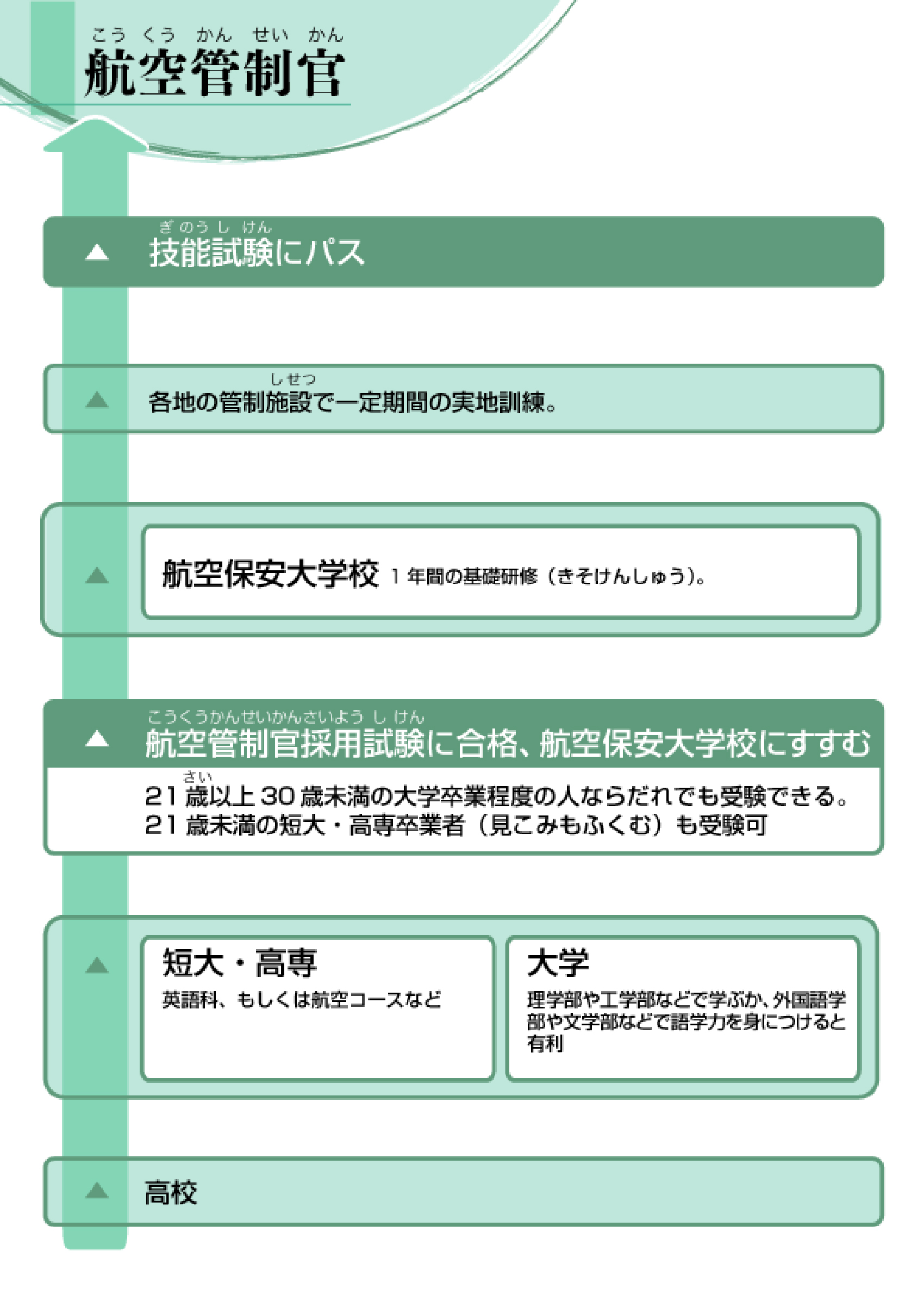
Air traffic controller is one of the professional positions in the national civil service. To be eligible for the job, one must pass the "Air Traffic Controller Recruitment Examination. The examination is open to those who are between 21 and 30 years old, and who have graduated or are expected to graduate from a university, or have graduated or are expected to graduate from a junior college or a technical college. The examination is divided into two parts: a basic test of knowledge and education required for civil servants, and an aptitude test to determine whether the applicant is suitable for the position of air traffic controller. In particular, since communication between air traffic controllers and pilots is conducted in English, the air traffic controller employment examination tests English listening comprehension and English conversation skills. Aircraft do not travel on a two-dimensional plane like a car, but in a three-dimensional space with heights; two aircraft can cross at the same point at different heights. Air traffic controllers are required to be able to visualize such three-dimensional space. The ratio of applicants who pass the employment examination for air traffic controllers, which tests their specialized skills, is considerably higher than that of other national civil service examinations.
After passing the employment examination and the Self-Defense Forces Air Traffic Controller
Passing the air traffic controller employment examination does not mean that you can work as an air traffic controller right away. After being hired as air traffic controllers, they undergo approximately eight months of training at the "Air Navigation College" in Osaka. After completing the training, they are assigned to airports and air traffic control departments around Japan. There, they undergo skills training and specialized training, and obtain skills certification and operational qualifications. For example, at airports, there are two types of duties: airfield control and radar control. Then, they are finally able to work as air traffic controllers.
The Air Self-Defense Force also performs air traffic control duties at 15 Self-Defense Force airfields nationwide. To become an air traffic controller of the Air Self-Defense Force, a person must pass an aptitude test including a physical examination and English proficiency test after joining the Air Self-Defense Force, and be selected as an air traffic controller. Selected members then spend about one year at a school in Komaki Air Base, Aichi Prefecture, learning the basics of becoming an air traffic controller. After graduating from that school, they are assigned to air traffic control units throughout Japan for training. After about one to three years of training, they obtain a national qualification called "Air Traffic Control Skills Certification" to become a full-fledged air traffic controller.
In the Future
More use of airports and more work for air traffic controllers.
Japan aims to become a "tourism-oriented country" with tourism as a major source of national income, so much so that it plans to increase the number of air arrivals and departures at Haneda Airport in Tokyo and Narita Airport in Chiba to about 1 million per year in order to increase the number of foreign visitors to Japan to 60 million by 2030. At the same time, the number of arrivals and departures at airports nationwide is expected to increase. The work of air traffic controllers will continue to increase. The increase in the number of incoming and outgoing flights will make operations more complex, and there is a risk that a small error in air traffic control operations could lead to a major problem that paralyzes the functioning of the airport. The work of air traffic controllers, who are responsible for the safety of the skies, is sure to become even more important.
Job Facts
Income.
The average annual salary is 4.66 to 6.49 million yen. Salary is also paid during the training period at the Air Navigation College after passing the employment examination for air traffic controllers. After completing training, the salary includes air traffic control allowance, night special duty allowance, and night shift allowance.
Vacation?
The work schedule varies depending on the hours of operation at the airport to which you are assigned, but generally you will repeat the early shift, late shift, night shift, and holidays. Vacations can be taken at a rate of about two days per week. You can also take 20 days of paid vacation a year.
Where do you work?
Control towers, radar rooms, and air traffic control departments at various airports. Every few years, there are nationwide personnel transfers to different locations.
Your Future Path
It's a chart that shows at a glance the main routes to a job as an air traffic controller!