

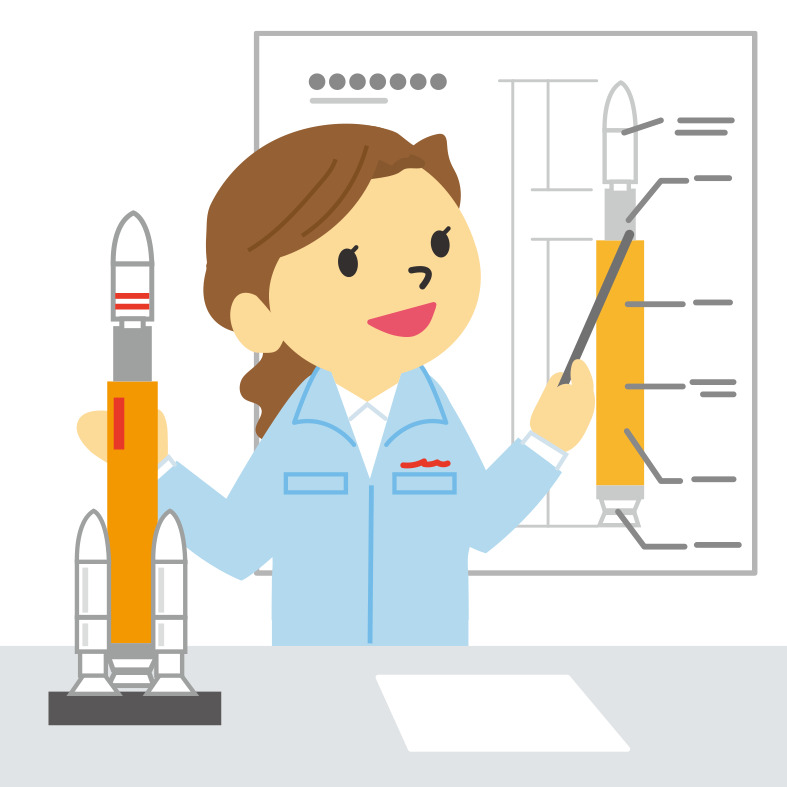
The blueprints for building a rocket consisting of more than one million parts are created. Launching a rocket is a big project that involves many people besides designers, including manufacturing staff and launch staff.
Perfect For …
A person who is dynamic. A person who values teamwork.
Job Details
Create a blueprint for building a rocket
A rocket is a transport vehicle that carries a satellite or human spacecraft into outer space. The rocket designer's job is to create the blueprints for the rocket. A rocket consists of many parts, including the payload space for satellites, the engine and fuel tank, the pipes that connect them, the attitude control electronics and the cables that connect them, and the fuselage that holds them. Moreover, the rocket during launch is subjected to severe vibration and a heavy load due to the defying of gravity, so it is necessary to calculate the strength of each component and select the optimum materials to withstand these loads. In addition, the overall structure and design of the rocket must be considered in order to effectively extract performance from the rocket, including the weight balance of each component and the layout of the engines. Furthermore, in the case of "commercial rockets," which are contracted to launch satellites for other countries or private companies, it is also important to make the vehicle easy to build and easy to operate for pre-launch inspections in order to keep costs low. The design drawings are directly related to the performance of the rocket, so the responsibility of the designers involved is heavy. For this reason, it is a very rewarding job. In addition, many people are involved in the development of a rocket. A small mistake due to lack of communication can lead to a major accident. To prevent this, the work requires teamwork and good communication between people.
Key Points !
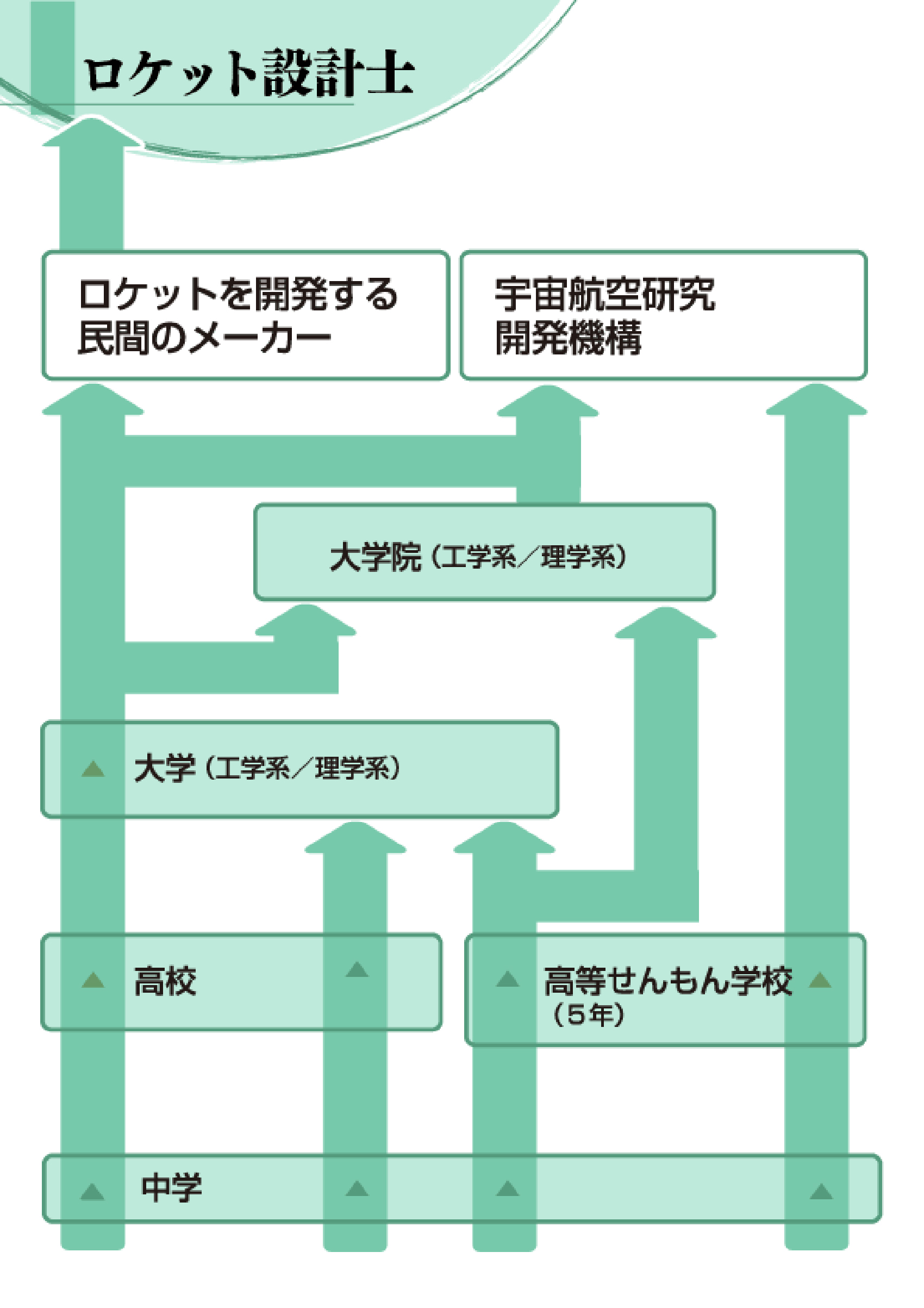
Studying engineering and science skills and knowledge at universities and other institutions
There are no special qualifications to become a rocket designer, but specialized knowledge related to rocket development and design is necessary. It is effective to enter a university, junior college, vocational school, or technical college with departments of space engineering, mechanical engineering, aeronautical engineering, etc., to learn basic knowledge. Many students go on to graduate school to acquire more specialized knowledge. After graduation, they are more likely to be involved in rocket design by working for a company that develops and manufactures rocket bodies. Incidentally, Mitsubishi Heavy Industries manufactures the H2A rocket, Japan's mainstay large rocket, and is also in charge of the launch business. The Epsilon launch vehicle, a small, individual-fuel rocket, is being developed by IHI Aerospace. There are also a number of other companies that assist in rocket development. Furthermore, the space-related business market is currently growing on a global scale, and many space development-related companies have sprung up in Japan. Some companies are actually developing small rockets, so the number of job opportunities for people who want to become rocket designers will continue to increase.
Developing rockets at JAXA (Japan Aerospace Exploration Agency)
JAXA, a national research and development agency, is responsible for Japan's space development, and the H2A and Epsilon rockets were jointly developed by JAXA and a private company that manufactures the rockets. There are no special qualifications to become a JAXA employee. New graduates are eligible to apply if they have graduated from or completed a junior college, technical college, vocational school, university, or graduate school. In addition, "rocket research and development work" is also offered in the "career recruitment" section, which recruits people with specialized knowledge. By applying for a position at another company after honing your knowledge and skills, you may be able to advance to the path of rocket development. Incidentally, the requirements for employment as a researcher in charge of projects conducted by JAXA are quite difficult, as only those who have completed graduate school and have a doctorate degree are eligible. D. degree. Since there is a lot of communication with overseas research teams, English and other language skills are also necessary.
In the Future
Japan also develops manned rocket?
The National Aeronautics and Space Administration (NASA) of the United States has launched the Artemis mission, the first moon mission since the Apollo missions, in the fall of 2022. As of 2022, Japan's main rocket for satellite launches is the H2A rocket. The development of its successor, the H3 rocket, is also underway. Once the Epsilon launch vehicle is in successful operation, the development of improved versions of it and new launch vehicles will begin. Also, when private companies begin to launch satellites in earnest, they will need rockets to be used for these launches. Rocket designers will have an increasing role to play. Incidentally, the Japan Society for Aeronautical and Space Sciences predicts that in 2050, "several lunar bases will be completed, and not only space workers and researchers but also space travelers will stay on the Moon for a short time. By then, Japan may have developed a manned rocket to transport travelers to the lunar base.
Job Facts
Income.
Although it varies depending on the place of employment, the average annual salary for employees of private companies ranges from 4.2 to 5.31 million yen; for JAXA, the average annual salary is 4.1 to 5.5 million yen.
Vacation?
Weekends off. Overtime may be required before rocket completion or just before project goals.
Where do you work?
Office of a private company, JAXA. During rocket launches, we sometimes watch over the launch site.
Your Future Path
It's a chart that shows at a glance the main routes to getting a job as a rocket designer!