




potter
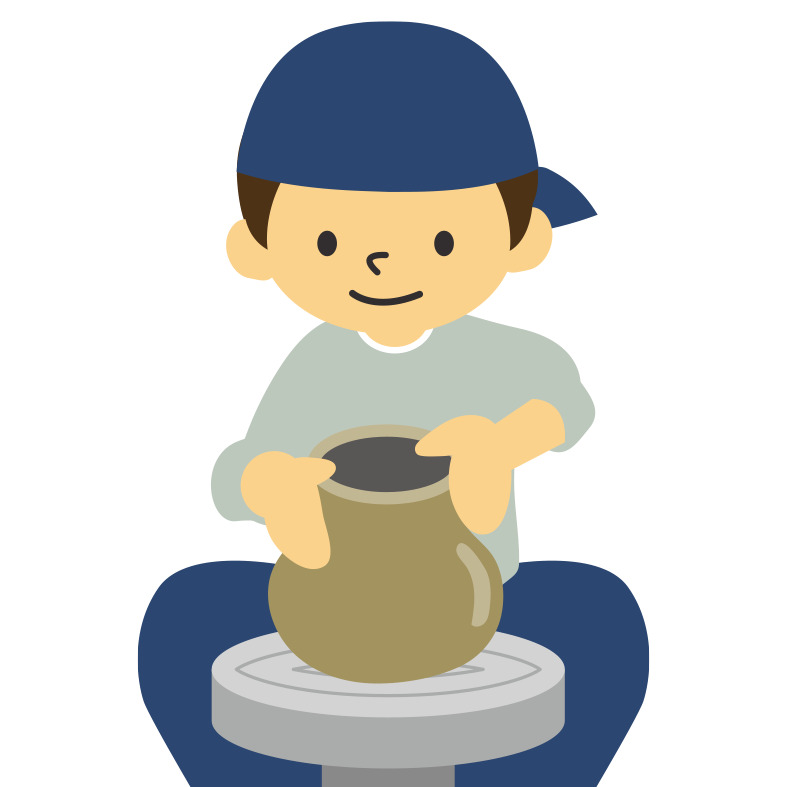
They produce tableware such as teacups and plates, and decorative pottery such as vases and flower vases.
Perfect For …
People who like to make things. People who are easily enthusiastic about things and like to work hard.
Job Details
Craftsmen who create tableware, jars, and other items from clay.
Clay is kneaded to form teacups and plates, which are then fired in a kiln to make ceramics. Various types of works are produced depending on the type of clay, how it is kneaded and formed, how the "glaze" is applied to make the surface of the vessel glassy, the firing temperature, and how it is painted. Incidentally, earthenware made by people in ancient times was fired at 600 to 900 degrees Celsius, while pottery is fired at 900 to 1300 degrees Celsius and porcelain at 1200 to 1400 degrees Celsius. There are also two main methods of shaping clay: one is to make beautiful circular vessels by placing one's fingers on the clay placed on a rotating platform called a "rokuro. The other is "Tebineri," in which any shape, not limited to a circle, can be created. There is another method called "kataoshi," in which clay is placed in a fixed "mold" and shaped. Some works are made as works of art to be appreciated, but most ceramics were made as tools for daily life, so they must be not only beautiful to look at but also easy to use. Some potters sell the works they create in this way, while others hold pottery classes or teach at culture centers.
Key Points !
He joined a kiln and trained while working.
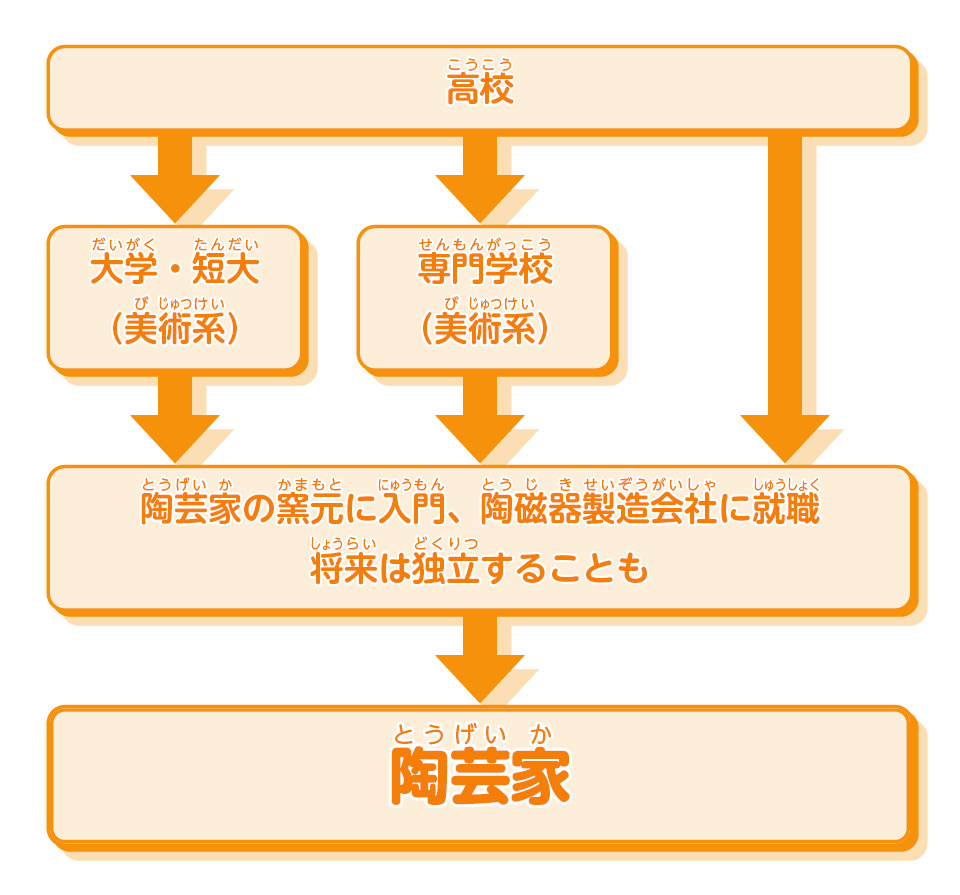
There are no special qualifications to become a potter. It is common for a person to become an apprentice to a potter, called a "potter," or to work for a ceramics manufacturing company, gaining experience while working. Another option is to enter a technical high school, vocational school, or art college where one can study ceramics, learn basic techniques and specialized knowledge, and then enter or work for a potter after graduation. Aspiring potters should try to actually see and hold many ceramic works in their hands, and determine what kind of pottery they want to make. Once they have decided on a career path, they should enter a kiln that produces that type of pottery. By making a large number of vessels, you will learn the techniques and the tricks of the trade on your own body. It is said that it takes at least 5 to 10 years to become a full-fledged potter, so you need to be patient and work hard to improve your technique and aesthetic sense. In the future, it is not a dream to become independent from a kiln or a ceramics manufacturing company and sell one's original works as a freelance potter.
In the Future
Expectations for potters to create new works of art
With its long history, pottery is one of the indispensable tools of human life. Today, however, lifestyles have changed, and many people use plastic tableware, which is less likely to break. In addition, discount stores now offer foreign imported tableware that is mass-produced by machines at low prices. Some potters are struggling with declining sales due to these factors. However, the way in which they sell their works has changed dramatically. Previously, they dealt with customers who visited their private exhibitions or galleries, but now they can deal with the whole world through the Internet. Pottery fans around the world are looking forward to the emergence of new ceramic artists who will create new works of art.
Job Facts
Income.
If you work for a ceramics manufacturing company, your annual salary is 4.2 to 7.9 million yen. Popular ceramic artists whose works sell under their own name can earn many times that amount.
Vacation?
If you are an entry-level kiln owner, you have about one day off per week. If you are working freelance, you are free to decide. However, since it takes time to create a work of art, some people do not take a day off to work on their creations.
Where do you work?
Individual potteries, ceramics manufacturing companies, pottery classes at culture centers, etc.
Your Future Path
It's a chart that shows at a glance the main routes to a career as a potter!