





animator
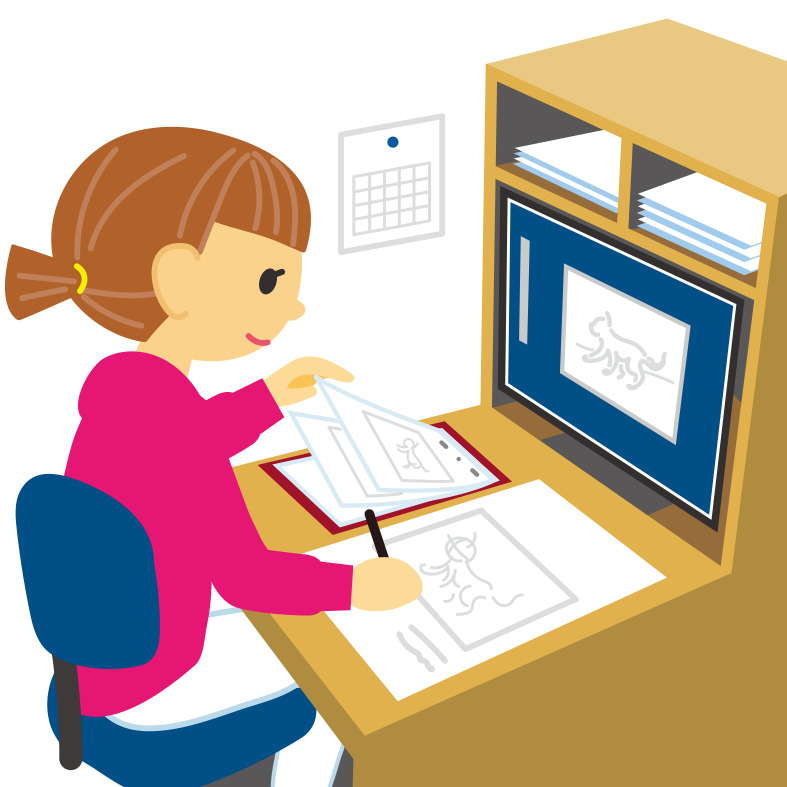
A behind-the-scenes force behind the world's favorite "made-in-Japan" animation. Hard work, but high profile.
The "Japanese Animation" team is a group of people who work hard, but are highly sought after.
Perfect For …
People who enjoy drawing, sketching, and other forms of painting. People who can carefully observe the movements of people, animals, and objects. People who are persistent, focused, and confident in their physical strength.
Job Details
Draw a large number of pictures that form the basis of the animated images.
An animation in which a picture appears to move even though it is actually still. The mechanism is based on the visual "afterimage phenomenon," in which a series of pictures that are slightly different from each other appear to move when viewed in succession. This is the same mechanism used in "para para manga," in which a picture is drawn in the corner of a notebook, and when the notebook is turned over quickly, the picture appears to move. The job of an animator is to draw a large number of such "slightly different pictures. There are two types of pictures that differ slightly from one another: "original drawings," which are the key points of movement, such as the beginning and end of a movement, and "moving pictures," which are the pictures that connect the two original drawings. Since the process involves dividing the original picture and the original picture, the animation is also called "mid-division". Incidentally, the original picture is sometimes divided into two processes. The "first original" is a rough sketch of the composition, and the "second original" is a clean copy of the rough sketch that has been corrected by the "animation director," who is the person in charge of directing and drawing the animation. The "animation man" in charge of animation first takes a copy of the original (second original) and then draws a number of moving images accordingly. The number of moving images varies depending on the desired image. The more moving images, the smoother the motion, and the fewer the number of moving images, the faster the motion. The "animation man," who is in charge of the original drawings, and the animation director are responsible for deciding the number of moving images. The animation man creates smooth moving images with the specified number of pieces. Animation artists who have achieved success in creating a large number of accurate animated images are promoted to the position of original picture artist, and those who have developed their skills become animation directors or "character designers" who design the characters for animation. As they gain experience as an original picture man and animation director, they can also work as freelancers. Some animators go on to direct and supervise other animators.
Key Points !
Drawing skills are important for aspiring animators.
There are no special qualifications to become an animator. What is required is the ability to draw pictures. However, it is not the ability to draw artistic and unique pictures, but rather the drawing ability to accurately depict the human body and express imagined movements. In order to match the character design, it is also important to have good copying skills. If you are confident in your drawing skills acquired through self-study, you can submit a "portfolio," a collection of your works including sketches of the human body, to an animation production company for an entry test. For those who want to gain confidence in their drawing skills and learn the basics of animation, it would be advantageous to study drawing and animation techniques at an art or art-related university, junior college, or a vocational school that trains animators. If you are able to join an animation production company, you will start working as an animator, which is the first step for an animator. Since this is a busy job, it is necessary to make an effort to acquire skills by accurately tracing the drawings of the animation director and original picture man in order to create fast and accurate animations.
Some animators do not draw pictures.
Animation is not limited to "2D animation," in which a picture drawn on a flat surface (2D) appears to move. There is also "stop-motion animation," in which a three-dimensional (3D) doll or other object is gradually moved and filmed frame by frame with a camera. The mechanism by which the motion appears to move is the same as in 2D animation, and some works use slightly different photographs in place of the pictures in 2D animation. In stop-motion animation, it is the animator's job to gradually move the puppets and other objects that are being filmed. In addition, we often see works that use 3D computer graphics (CG) to create all of the images. Even in such "3DCG animation," the animators are in charge of making the characters move. In both stop-motion animation and 3DCG animation, animators may sketch ideas for movement, but they do not directly draw pictures. However, in both cases, the characters appear to be moving vividly in a way that is different from drawing pictures. The origin of the word "animation" means "to bring to life," so even if the production techniques are different, the animator's job is the same. If you are not good at drawing pictures but would like to become an animator, why not add animation to your goals?
In the Future
Digital drawing streamlines the work process.
Until about 10 years ago, a large number of pictures called "celluloid pictures" were used in animation production. Animators used a special machine to copy the pencil drawings on paper onto transparent sheets (cels) one at a time, and colored the necessary parts of characters and other objects with special paints using a brush. The cell is then placed on top of the background picture, and the cell is photographed frame by frame on film, replacing the cell picture in the order of movement. When the film is projected, it appears to move. Now that celluloid pictures are no longer used, the hand-drawn motion pictures are scanned into a computer, and the digitalized motion pictures are colored using photo processing software. This data is then combined with background art data and sound data, and special effects are added to complete the video. Except for the animators' original drawings and animated images, most of the work is done on the computer. Recently, however, the original drawing and animation work is also being digitized. Instead of paper and pencil, "digital drawing" is increasingly being done using a "pen tablet" to input drawing data directly into the computer, just as if drawing a picture. This eliminates the need to scan paper, and allows the artist to proceed immediately to the coloring and visualization processes, which is expected to improve work efficiency. In addition, advances in AI have led to the creation of software that can automatically generate moving images (mid-size split). Animations of simple movements that neatly connect between original drawings have come to be created by AI. However, excellent animators do not divide the animation evenly, but instead add animation techniques such as exaggeration and omission to make the movements look natural. Future animators will be required to have more advanced techniques to express complex movements. Aspiring animators should work on their drawing skills and imagination, and become familiar with the use of digital devices such as PCs and tablets.
Job Facts
Income.
The average annual salary ranges from 3.49 to 5.46 million yen. Animators are often paid on a "piece-rate" basis, meaning that they are paid for the work they do. The number of original drawings for one cut (a short clip before the camera switches) is about 5 to 10 for simple movements. The more complex the movement, the more original drawings are required. The unit price for original drawings ranges from 1,600 to 5,000 yen per cut, with some original picture artists working on 100 cuts in a month. On the other hand, for moving images, the wage is for one moving image and ranges from 150 to 400 yen per image. The number of pictures an animator draws in a day is about 20, but the amount of work and income varies greatly depending on the content of the pictures and the animator's ability. In particular, the high quality of today's animated films means that it takes longer to complete a picture, which reduces the amount of work. The income is low for the hard work, so many newcomers have a hard time making a living.
Vacation?
Employees of animation production companies do not have much hope for paid vacations or a full workweek like those in large corporations. Depending on the progress of the work they are in charge of, they may have to work all night. As a freelancer, you can take time off between jobs.
Where do you work?
Studio of an animation production company. For freelancers, a home workplace.
Your Future Path
It's a chart that shows at a glance the main routes to getting a job as an animator!