




reporter

They cover and report a variety of news ranging from politics and economics to crime and other incidents, sports, entertainment, and daily life. His activities include newspapers, magazines, television, and web media.
Perfect For …
A person with a strong sense of curiosity, especially about people. Since the mission is to deliver the news accurately and quickly to as many people as possible, they must also have a strong sense of justice and responsibility. It is a busy job, so it also requires stamina and energy.
Job Details
Tough job with some late-night and early-morning interviews!
Reporters include newspaper reporters, magazine reporters, and TV news reporters, but there is also a growing number of web media reporters who transmit their work via the Internet. Although the media may differ, the work of a reporter is basically the same. They interview the people involved in the incident or event, summarize the facts that come to light in an article, or report on the incident or event themselves, and communicate them to readers and viewers. It is not unusual for reporters to work late at night or early in the morning, and they are required to be tough both physically and mentally.
Key Points !
Getting a job at a major company is a narrow gate. A wide range of knowledge is the deciding factor!
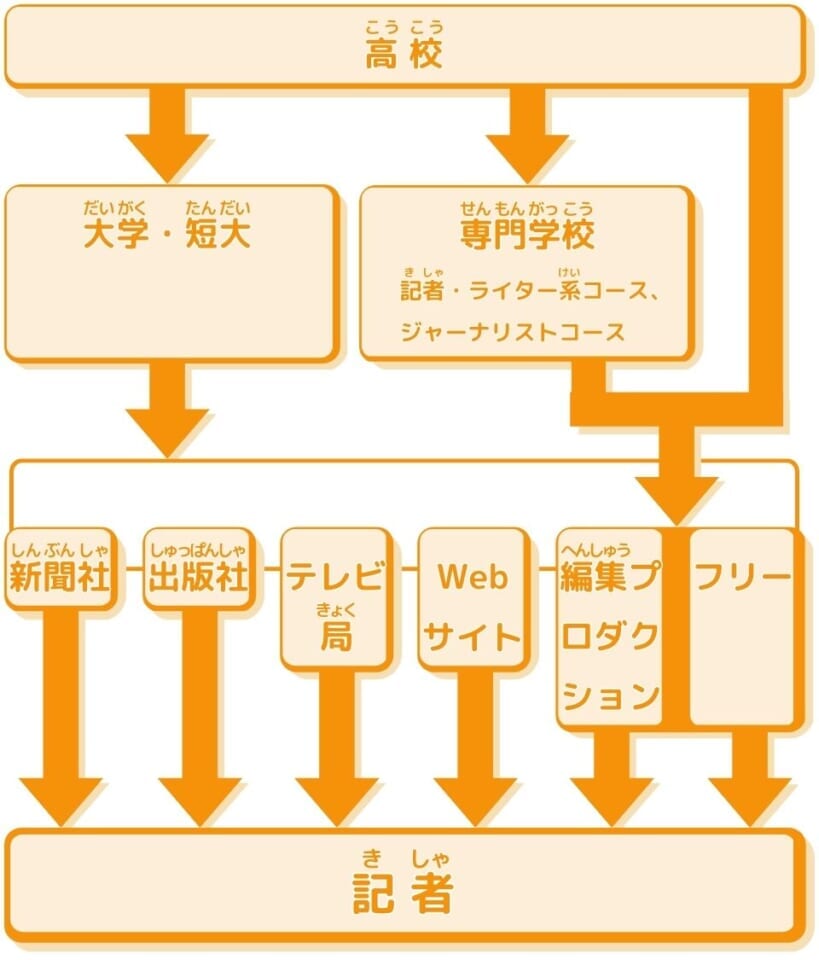
Although reporters do not need licenses or qualifications, most new graduates hired by major companies such as newspaper companies, publishing houses, and broadcasting stations are college graduates. Moreover, competition is high. In addition to current affairs, a wide range of knowledge is required for the entrance examination, and language and writing skills, as well as good judgment and communication skills are also considered important during the interview. However, it is possible to work as a reporter without a university degree. In many cases, they work for editorial production companies or as freelance "correspondents" under contract to major news organizations.
In the Future
The Internet is becoming an increasingly important means for the general public to obtain news and information. Print media such as newspapers and magazines take time to print and deliver, and are no match for Web media in terms of delivering information quickly. More and more reporters may become active mainly in the Web media. The general public is now transmitting information via social networking services (SNS). This will be the era of reporters who have a wide range of knowledge and the ability to act in any media, not limited to print, web, or TV.
Income.
A mid-level employee at a major TV station, publishing company, or newspaper company with 12 to 13 years of service earns about 400,000 to 500,000 yen per month. Since they also receive overtime pay for late-night work, it can be said that their income is higher than that of other occupations. At regional bureaus, small- and medium-sized publishing companies, and newspaper companies, income depends largely on the performance of the company.
Vacation?
So-called mass media workers, such as newspapers and TV stations, do not always have time off, even on weekends and holidays, because their production schedules take precedence. Adjustments are made with compensatory time off.
Where do you work?
Newspapers, publishers, TV stations, news agencies, websites. Or editorial production companies under contract with them. Some reporters work on a freelance basis.
Your Future Path
It's a chart that shows at a glance the main routes to getting a job as a reporter!