




editor (in publishing, etc.)

Books such as novels and practical books, magazines such as manga and fashion magazines... All books are planned and produced by editors. This is an important job that involves the entire book-making process from start to finish!
Perfect For …
People who enjoy reading books and magazines. The ideal candidate is someone who has had fun creating class books, class newspapers, and so on. The job of an editor is to make books about things that people in the world find interesting, so you are expected to be interested in and impressed by a variety of things on a regular basis and to be sensitive to trends. In addition, since books are created in cooperation with various people such as authors, illustrators, photographers, and graphic designers, communication skills, cooperativeness, and leadership are also necessary.
Job Details
All-around ability is required from book planning to completion.
Editing a book or magazine means gathering many texts, photos, illustrations, and other materials and putting them together in one volume. The first step in such editing work is to plan what kind of book or magazine it will be. The first step in the editorial process is to plan what kind of book or magazine it will be, who will be involved in its production, what the schedule will be, and what the budget will be. Once the book production starts in earnest, we first ask writers of novels, illustrators, manga artists, etc. to submit manuscripts. If there are articles to be interviewed, the editor contacts the interviewees. In general, editors do not write manuscripts, but they may be present during interviews with writers and photo shoots by photographers. It is also the editor's job to manage writers and editors to ensure that novels and article manuscripts are completed on schedule. Once a manuscript is completed, the editor checks it for errors in writing and content. In addition, a graphic designer is asked to design the entire book in order to make it look good. Once all the materials have been prepared, the data for printing is compiled on a computer and sent to the printing house for proofreading, where test printings are checked. If there are no problems, the book is actually printed and completed. The editor's job is to be involved in all of these book-making processes. Of these, planning is particularly important. For this reason, many editors are constantly on the lookout for topics that could be featured in books, frequently checking newspapers, magazines, television, and the Internet, and expanding their network of contacts to increase their knowledge and information. Other times, they handle sales work in order to get their books placed in bookstores. Incidentally, in the case of editors of manga magazines, the manga artist and the editor in charge often work in tandem to create the world of the story and the characters. There are many other things that the editor in charge should do. They discuss "names," which are the blueprints for the manga, gather materials, check manuscripts, give instructions for revisions, and check the progress of the work. It can be said that the editor in charge, who is deeply involved in the creation of the work, plays a very important role in manga production.
Key Points !
If you want to be a major publisher, go to college!
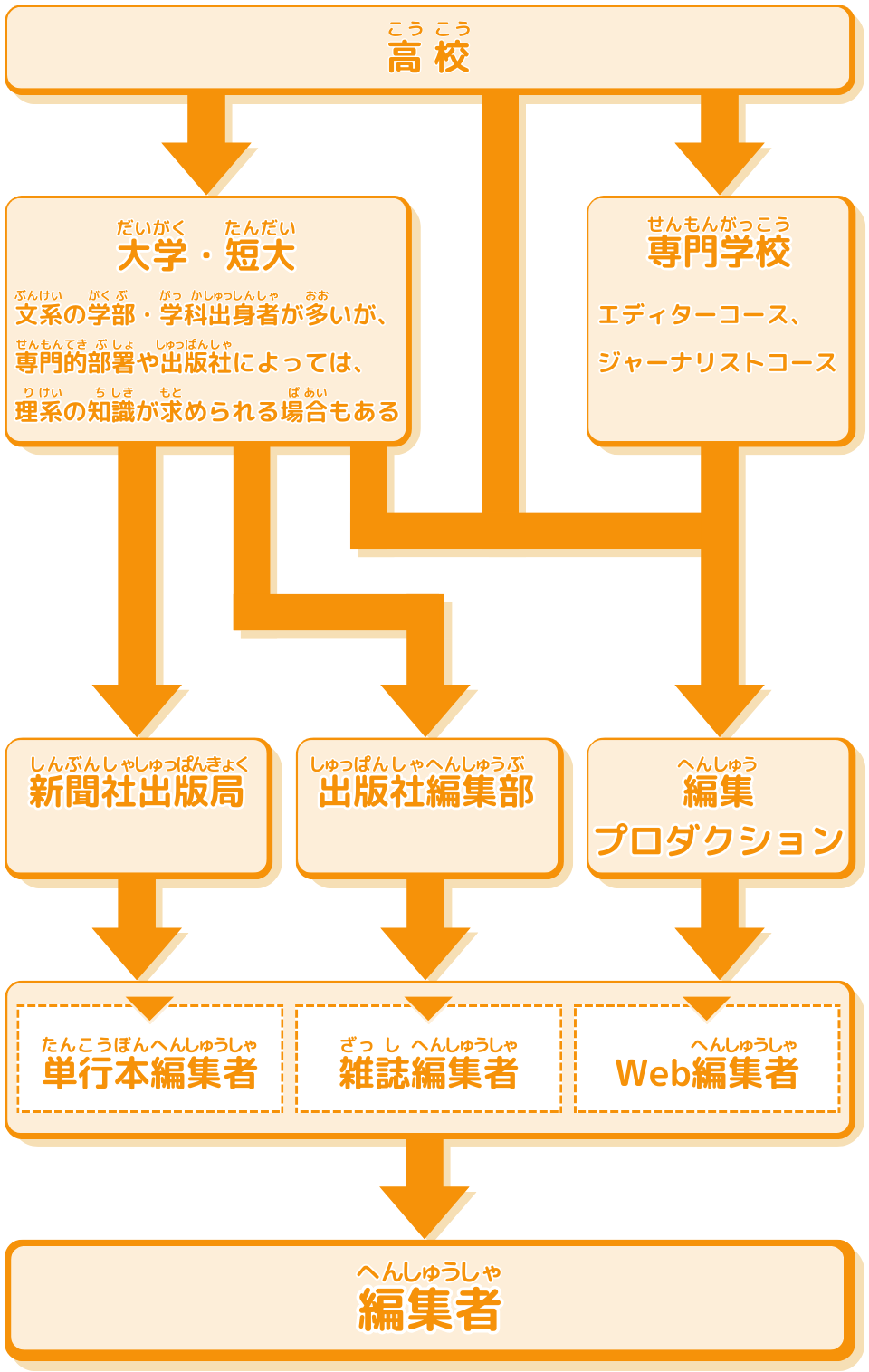
There are no qualifications required to become an editor, but one's educational background may be questioned. One possible way to become an editor is to join a publishing company, but most major publishers and newspaper publishing bureaus require that applicants have graduated from a four-year university to take the entrance examination. Those who wish to join such publishing houses should first aim to go on to university. However, even if you are admitted to a major publishing house, you may not necessarily be assigned to the editorial department of your choice. You may have to wait for a chance to be assigned to the editorial department while gaining experience in the publishing world in the advertising department, sales department, or publication planning department. However, the same can be said for the four years of college, but every experience has the potential to become a story for making a book. We want to be actively involved in a variety of things.
Aimed at small and medium-sized publishers and editorial production companies.
Many small and medium-sized publishing houses and editorial production companies that work as subcontractors for publishing houses do not require education as a condition for employment. Although they mainly hire experienced mid-career workers rather than new graduates, some open their doors to graduates of junior colleges and vocational schools. Some people enter vocational schools after graduating from high school to acquire basic editorial knowledge before entering such workplaces. Small and medium-sized publishing houses and editorial production companies may also recruit contract or part-time workers. Some people become full-time employees by applying for such positions and acquiring know-how while assisting in editing, while others get jobs as freelance editors. Since being an editor is a job where practical experience is more important than anything else, it is important to take on a variety of tasks and actually experience many failures and successes.
In the Future
Developing print and website editing skills
Today, Japanese people do not read as much as they used to, and books and magazines printed on paper are not selling as well. Instead, the market for digital content such as e-books, which can be read on Internet websites, is expanding rapidly. Novels, manga, and articles published on such websites also have editors. The editing process is almost the same for books printed on paper and articles published on websites. However, in the case of websites, the work period until publication is much shorter than that for printed books, and the response from readers can be seen immediately. Therefore, it is necessary to use techniques unique to websites, such as devising ways to appear at the top of online search engines in order to attract more readers. In the future, editors will be required to have both basic print editing skills and website editing skills.
Job Facts
Income.
The average annual salary ranges from 4.02 to 7.4 million yen. Major publishing houses can be said to have a considerably high level of income compared to other industries. However, small publishers and editorial production companies, which make up the overwhelming majority, are not as fortunate in terms of income for their irregular and restrictive working hours. You will have to have a passion for making books to make it.
Vacation?
Basically, the weekends are two days off, but it varies depending on the editorial department to which one belongs. Editors who work on books that take a long time to be published can take off almost as per the calendar, but editors of regularly published magazines such as weekly and monthly magazines cannot expect to take off as per the calendar. Regardless of the type of company they work for, book production schedules take precedence, and it is common for editors to work on holidays or stay up all night every day before deadlines.
Where do you work?
The main workplaces are publishing companies, newspaper companies, and their subcontracting editorial production companies.
Your Future Path
It's a chart that shows at a glance the main routes to getting a job as an editor!