




television director

The person in charge of the production site who brings together a large number of staff members to create a TV program.
Perfect For …
A person who has a vivid imagination and the ability to execute ideas into shape. A person with good leadership and judgment. A person who is confident in his/her physical strength.
Job Details
Responsible for TV program production sites
Their job is to organize a large number of staff members and performers to create a program. The genres may vary from drama to variety to news, but no matter what the program, the TV director is involved in all aspects of the program, from planning, scriptwriting, selection of performers, and program direction to sound, lighting, and acting instruction, VTR composition, and editing, until the program is successfully aired. It is fair to say that the fun of a program depends on the TV director's skill. In the case of popular variety shows, there is often a director for each corner.
Key Points !
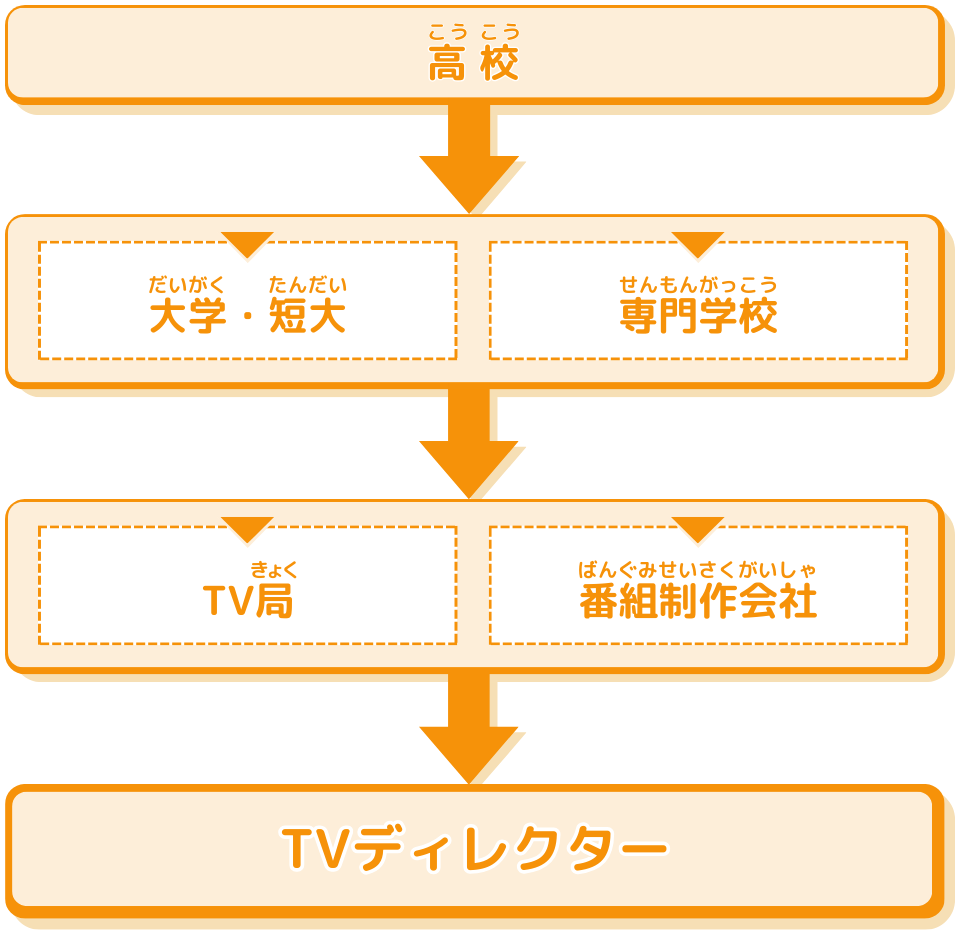
Aiming to join a TV station, although it is difficult.
One way to become a TV director is to join a TV station and be assigned to the production department if you wish; you start as an assistant director (AD) and learn the flow of program production. After gaining experience, you will write your own proposals and if they are approved, you will be assigned to the production department. If they receive an OK, they take their first step as a director, not an assistant. However, it is difficult to join a TV station itself, and the number of recruits is limited. Since the recruitment of new graduates is limited to those in their fourth year of university, it is essential to go to university.
Graduated from a vocational school or university in the visual and fine arts and entered a production company.
Another route is to join a program production company. TV stations are increasingly outsourcing program production to outside production companies. The requirements for joining a program production company are not as strict as those at a TV station, so there are many opportunities. Once you join a company, you will work your way up through the ranks to AD and then to director. No license or qualification is required to become a director, but studying at a university or technical college in the visual or artistic field is considered an immediate asset, and is advantageous when taking the entrance examination.
In the Future
The possibilities for video directors are expanding.
The number of people watching television is declining, partly due to the spread of the Internet. Even so, the role of TV directors, who are still required to create programs that can get viewer ratings, will become more important. However, the number of original programs distributed on the Internet, which can be said to be a rival to television, is increasing every year, and each of these programs also requires a director. If we consider the future of directors not only for television, but also for video productions more broadly, the possibilities for their activities are likely to expand.
Job Facts
Income.
Compared to those in their 30s, key TV stations (commercial TV stations headquartered in Tokyo) can earn more than 10 million yen a year, while local stations earn around 7 to 8 million yen. At program production companies, however, there is a big difference, with annual incomes of around 4 million yen.
Vacation?
Shifts with weekend work and irregular holiday patterns vary depending on the company and the program you are in charge of.
Where do you work?
Television stations (key stations and local stations) and program production companies.
Your Future Path
It's a chart that shows at a glance the main routes to getting a job as a TV director!