




narrator
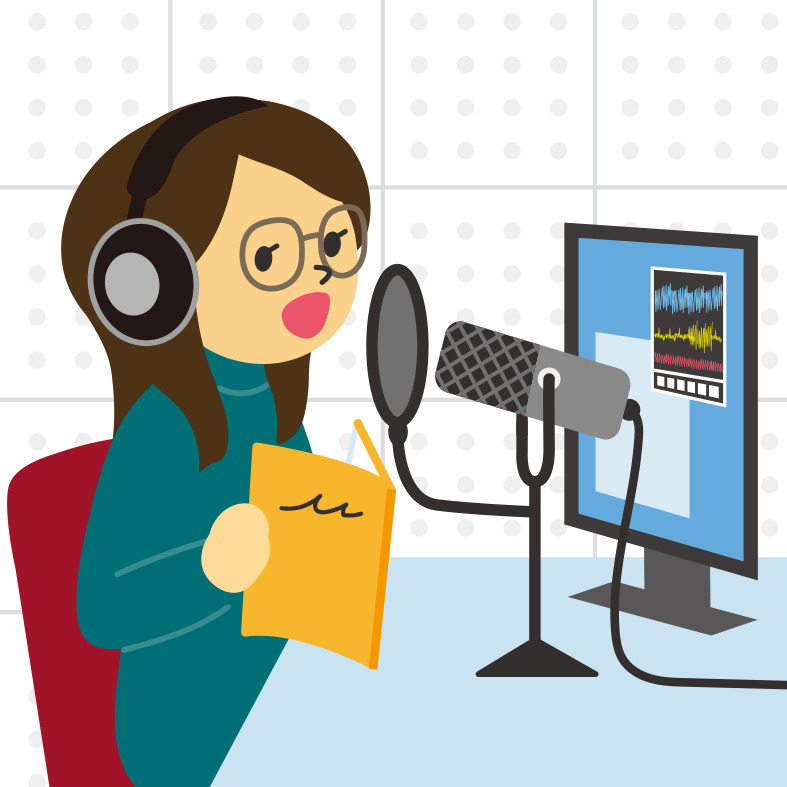
Voice work in television, radio, film, commercials, and other "narrative" work.
Perfect For …
People who like to express themselves with their voice, such as reading. People who have rich expressive power of voice. People who have a voice that attracts people.
Job Details
Casually inform people in a variety of situations
In television, radio, movies, commercials, and other media, the "narration" of the story, characters' feelings, and product descriptions is called narration, and the person in charge of it is called a narrator. Especially in TV variety shows, the narrator's unique voice and phrases are often used to liven up the program. In documentaries and news programs as well, the narrator's role is to create a strong impression on the viewer with a calm voice and a way of speaking that matches the content of the program. First, the narrator receives a script prepared by the program staff and discusses the reading speed, tone of voice, and other aspects of the script with them. If the narration is to be matched to the video, the narrator actually watches the video, and if not, he or she records the narration while paying close attention to the time. For live broadcasts, mistakes are not possible, so the narrator repeats rehearsals many times before going on the air. The difficulty of being a narrator is that, while the voice must be memorable, it must not interfere with the video, and the necessary information must be conveyed within the allotted time. Especially for commercials, the skill of reading a script to fit within a short time frame of 15 to 60 seconds is required. Narrators are needed not only for television and commercials. Narrators are also needed for "in-train announcements" that inform passengers of train stops and transfer information, using recorded automated voices. Narrators play an unobtrusive role in various aspects of our daily lives and are an important behind-the-scenes force.
Key Points !
First, attend a training school or school
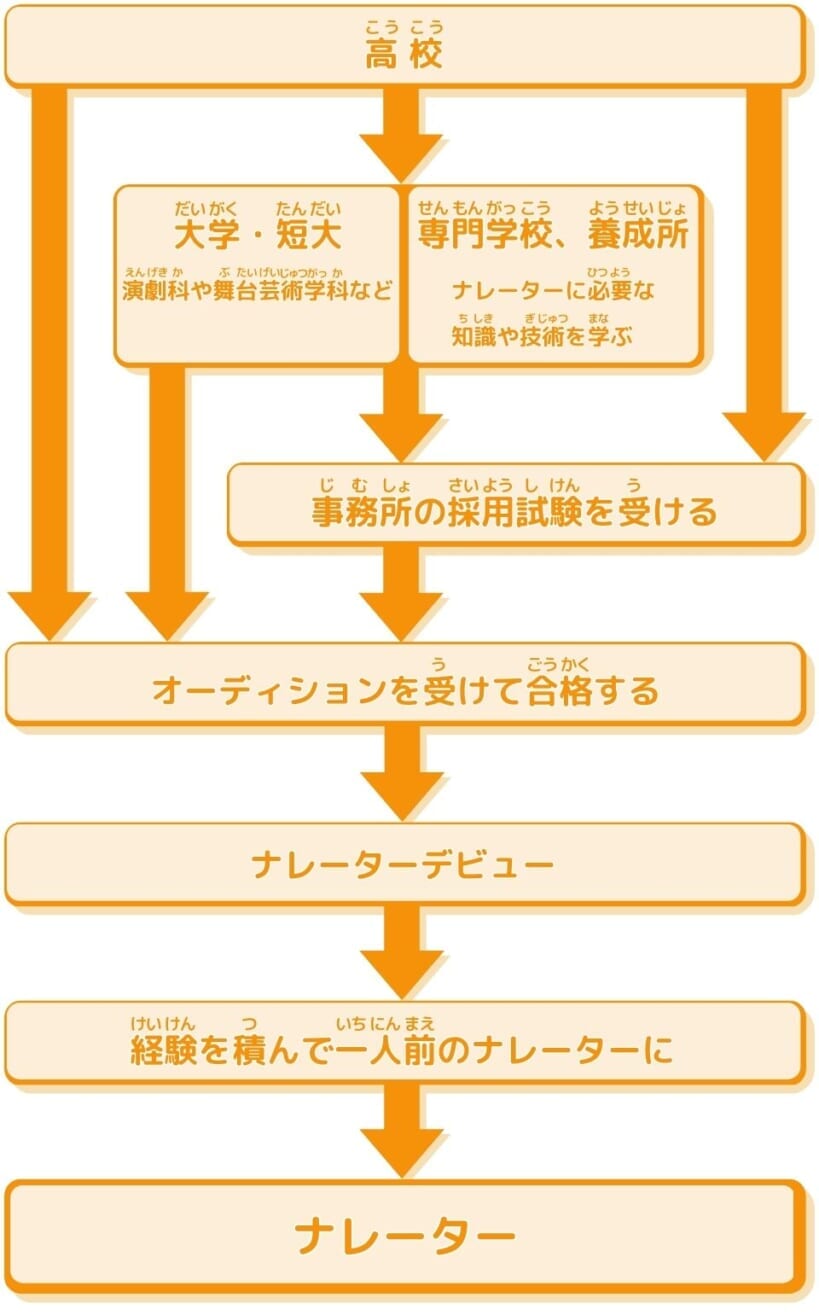
There are no special qualifications to become a narrator, and no educational background is required. However, there is little chance that someone without any experience in expressing themselves with their voice can become a narrator. First, attend a professional school such as a narrator training school or an announcement school that offers a narrator course to learn basic vocal techniques and how to express yourself with your voice. Voice actor training schools are also recommended to acquire voice acting skills. If you can improve your skills at such a training school and join an entertainment production company such as a voice actor or talent agency, it will lead to opportunities to audition for TV, movies, and commercials. On the other hand, there is another way to participate in auditions as a freelancer without belonging to an agency. Whether you belong to an office or freelance, it is up to your ability to pass the audition. It is a job that requires individual ability, so it is necessary to always strive to improve oneself.
Narrators, announcers, and voice actors have different ways of communicating.
There are also announcers and voice actors who use their voices to express themselves, like narrators. Each job differs in the way they communicate. The announcer's job is to read the news in the correct pronunciation and within the allotted time, and to convey information accurately. However, they must read in the same tone whether the news is upbeat or downbeat, so they are required to read without emotion. Voice actors are responsible for voicing cartoon characters and other characters. It is important to be able to convey the characters' lines with emotion in order to move the viewer's emotions. Narrators possess the best of both worlds: the skill to convey information accurately and the acting ability to move people. The fact that many of the narrators currently active in variety shows are veteran voice actors shows that narrators are required to have the ability to accurately convey information in a captivating voice.
In the Future
It is necessary to always have the mindset of self-discipline
Today, narrators have more and more opportunities to play an active role in the industry. This is because, in addition to conventional TV, radio, movies, and commercials, there is an abundance of video that requires narration, such as satellite broadcasting and Internet video programs. In addition to videos for public broadcasting, there are also videos and animations that are not available to the general public that are made by companies for work purposes. There is also the job of narrator-companion, which includes broadcasting inside museums and art galleries, providing audio guidance for bank ATMs, car navigation systems, home appliances, etc., and introducing products at exhibitions and other events. If a person can speak well and make witty comments in such situations, he or she will be a good narrator. Furthermore, it is said that a person's "human nature" is expressed in his or her voice. Narrators who work with their voices must always be ready to improve themselves.
Job Facts
Income.
Varies depending on job description, experience, and visibility. Average annual salary is 5.14-6.3 million yen.
Vacation?
It depends on the nature of the work. Depending on the schedule, work may take place on Saturdays and Sundays.
Where do you work?
TV stations, radio stations, program production companies, and recording studios. Freelancers may also record at home.
Your Future Path
It's a chart that shows at a glance the main routes to getting a job as a narrator!