




broadcast writer (TV and radio)

To create TV and radio variety shows and other programs, he comes up with various plans and ideas, and writes scripts to facilitate the programs.
Perfect For …
People who are driven towards their goals. People who can have fun no matter what. People who like to think of interesting things. People who are good talkers.
Job Details
Planning, structuring, and scriptwriting for the program.
Involved in the production of variety shows, documentaries, and information programs broadcast on radio and television, this job involves writing a "script" that describes the flow of the program's proceedings and the words of the performers' lines and narration. The recording of a program is done according to the script, so the script is like a blueprint for the program. The role of the broadcaster who writes the scripts is a significant one. The role of a broadcaster is not limited to writing scripts. It is also the broadcaster's role to think of "plans" for the program as a whole and for the program's corners, and to propose ideas that will make the program more interesting. The first step in the workflow is to attend a "planning meeting" where the program staff gathers and proposes a plan that they have brought with them. Since several broadcasters attend the meeting, there is a competition for the adoption of the plan. If their plan is adopted, they write a script based on the revisions to the plan decided at the meeting. For a variety show, they finish the script while paying attention to the tempo and groove of the program to make it exciting, such as when the host should turn the topic toward the guests. Even after the scripts are written, they attend the recording and sometimes rewrite parts of the scripts to help make the recording go smoothly.
Key Points !
Three types of writers who write scripts for broadcast programs
A job very similar to that of a broadcaster is that of a "composition writer. Both are involved in the production of TV and radio programs, and today they are often used almost interchangeably. If we were to venture to separate the two jobs, then a broadcaster is "a person who thinks about the direction of a program and writes scripts for the actors' lines and narration," while a scriptwriter is "a person who thinks about the concept (basic idea) of a program, the overall flow of the program, and the planning of corners," and so on. In reality, however, broadcasters sometimes come up with program plans, and composition writers sometimes write scripts. In radio programs, they are often called composition writers. Other jobs that involve writing scripts for broadcast programs include writing scripts (scripts and scenarios) for TV and radio dramas. In this case, however, one is a "scriptwriter/scenario writer" and is not called a broadcaster. Incidentally, the Japan Broadcast Writers Association, a cultural organization that brings together many broadcasters and scriptwriters, refers to "writers working in the broadcast media" as "broadcast writers.
Create opportunities to present your plans and ideas
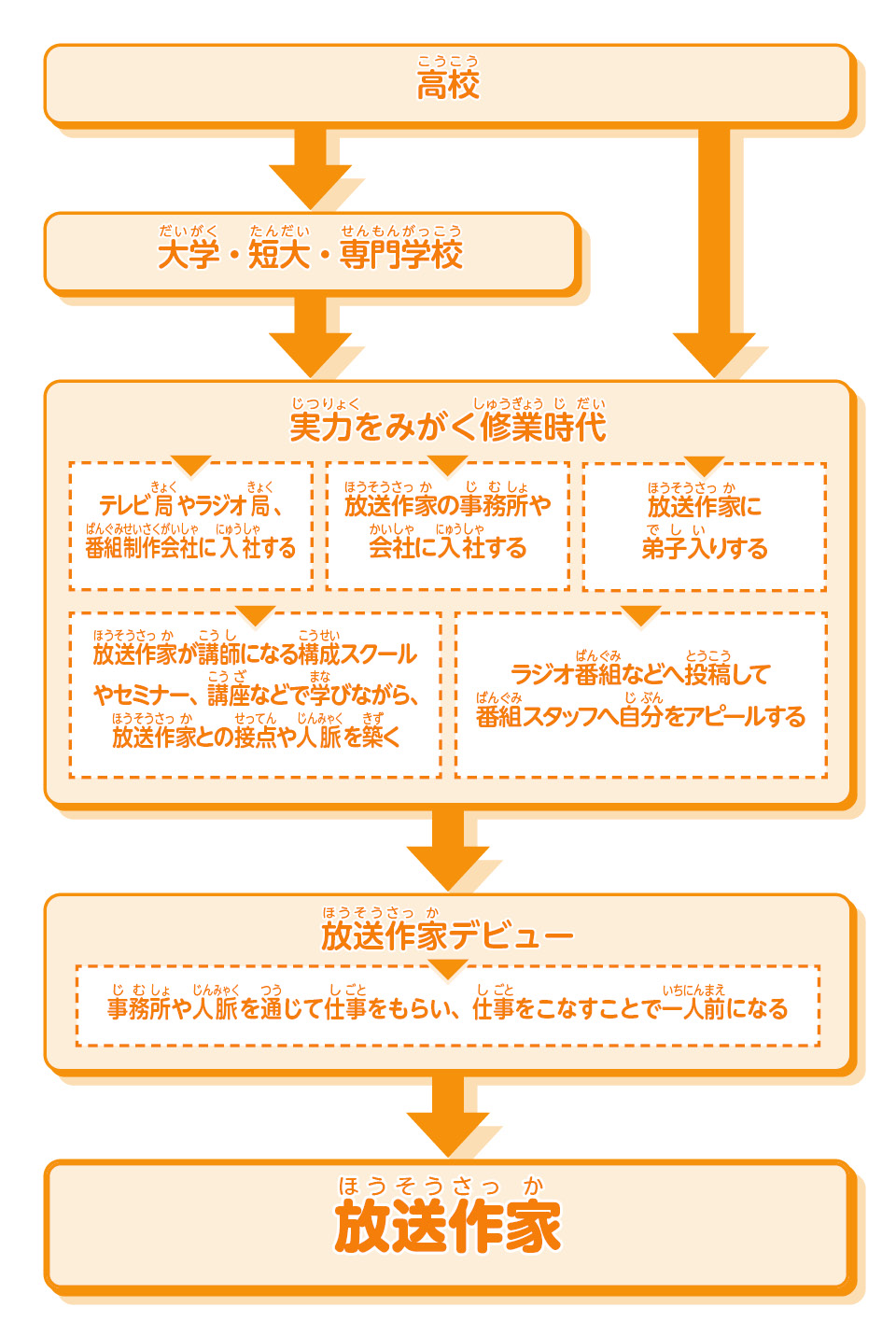
No special qualifications are required to become a broadcaster. Therefore, there is a wide range of entry points to becoming a broadcaster, and there are various ways to get a job. In terms of schools, there are various methods, such as studying at a vocational school, attending a broadcaster's seminar, or attending a course held by a broadcaster's office. If you want to learn the know-how of a broadcaster in the field of actual program production, you can join a program production company or a broadcaster's office, or apprentice yourself directly to a broadcaster. In the past, some people became broadcasters after their abilities were recognized by program staff and personalities through continuous contributions to radio programs. Also, comedians who are good at coming up with interesting ideas may turn into broadcasters. What is important is to develop the ability to come up with interesting plans and the writing skills to turn them into scripts, as well as to promote yourself and build a network of contacts in the broadcasting industry. It is important to create opportunities to present your own projects and ideas.
In the Future
In addition to TV and radio, the Internet has unlimited possibilities.
TV and radio programs in which broadcasters are active will not disappear in the future. In addition, the number of programs is increasing, not only through terrestrial and satellite TV broadcasting, but also through Internet video distribution services. This is an opportunity for broadcasters, who come up with "plans" and write "scripts," which are indispensable for program production, to play an active role in the industry. However, today, people, especially the younger generation, are no longer watching terrestrial TV. Many of them enjoy watching videos on YouTube and other video-sharing sites on their Internet-connected televisions. In response to this trend, some broadcasters have started a service to provide interesting projects for You Tubers who are having trouble coming up with new projects. The Internet, with its greater degree of freedom than broadcasting media such as television and radio, may be a place of unlimited possibilities for broadcasters to create and present a variety of projects.
Job Facts
Income.
The average annual salary ranges from 4 to 7.4 million yen. The unit price of a job varies, depending on whether it is fixed for each program or determined by the number of projects used. The monthly income varies greatly depending on the individual's ability and performance, ranging from several tens of thousands of yen when he or she is a newcomer to more than several million yen per month when he or she becomes a successful artist.
Vacation?
It is not set in stone. He takes time off in between planning, searching for materials, having meetings and discussions with the program staff, and being present at the recording sessions.
Where do you work?
TV stations, radio stations, broadcaster's offices, home workshops, etc.
Your Future Path
It's a chart that shows at a glance the main routes to getting a job as a broadcaster!