




director

In orchestras, operas, choirs, etc., they organize the performance. He not only adjusts the balance of sound and tempo, but also directs how the performance itself is expressed.
Perfect For …
Someone who loves music. A person who likes to organize everyone. A person who has his/her own particular way of thinking.
Job Details
Bring the orchestra together and control the expression of sound during the performance
His job is to unite the musicians of the orchestra by waving the baton (conductor's baton) and create a performance. If one were to compare it to other jobs, it would be like being a movie director or a stage director. Conductors have a strong image of being flamboyant, waving the baton in front of the musicians, but they perform a great deal of work that is invisible to the audience before the performance. First of all, he studies the score to be performed to understand the composer's ideas and what he wants to convey. In order to decipher the composer's thoughts that are not directly written in the score, he sometimes researches the composer's life and historical background. In addition, we consider the method of expression based on the pitch, rhythm, intensity of sound, etc. of all the parts written in the score. It is the conductor's role to bring out the best sound from each player in the orchestra. The next job is to convey his or her ideas, including the content of the score, to the performers and to guide them in their performances. During rehearsals, he gives detailed instructions on tempo, tone, etc., and refines the performance. Then, in the performance, he or she will wave his or her baton to direct the emotion of the piece, and through the sounds played by the performers, he or she will impress the audience. In this way, the most important role of the conductor is to elevate the performance to a work of art with thought and character.
Key Points !
Studied conducting at the Department of Conducting at the College of Music
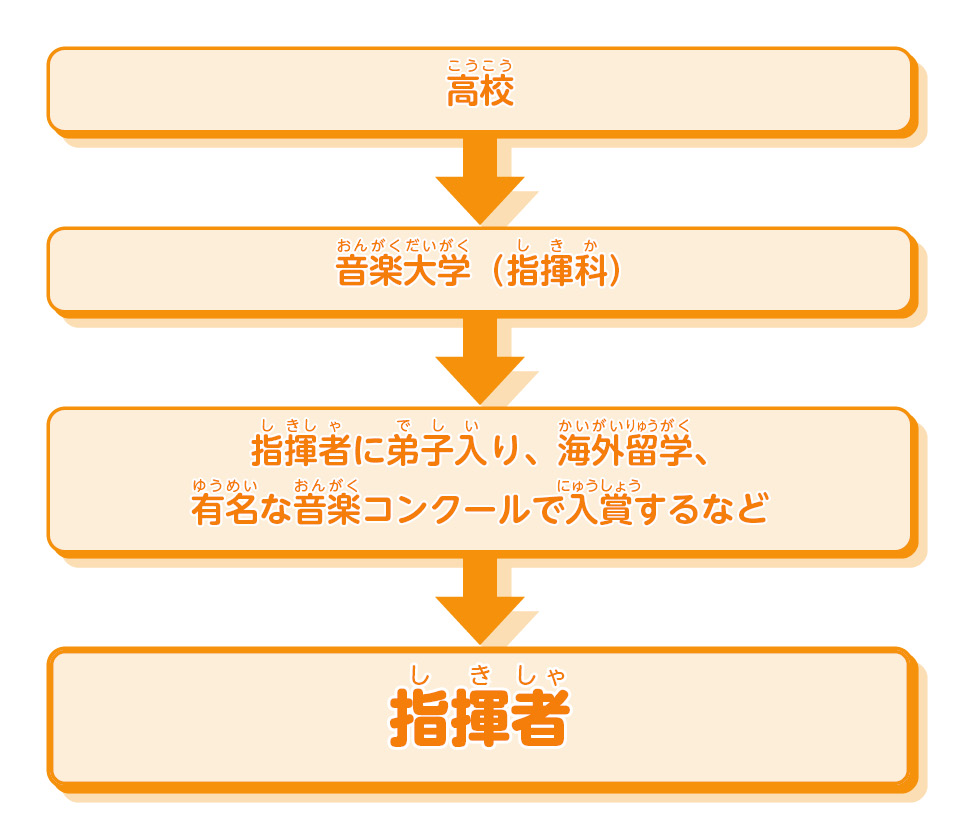
There are no special qualifications to become a conductor. Although it is possible to become a conductor on one's own, specialized knowledge of music is necessary, so it is common to study conducting at a college of music. However, to enter the conducting department of a college of music, one must have advanced piano skills and knowledge of music such as harmony. Aspiring conductors should begin piano lessons as early as possible. In the conducting department of a college of music, students learn how to read music and compose through basic music-related exercises and "aural music" exercises, in which they listen to sounds and transcribe them into musical notation. Students also learn the history of music and how to play musical instruments, which are essential for conducting, and acquire the skills to actually conduct an orchestra and wield the baton. Some students go on to study at overseas music schools while still in school or after graduation. This is an opportunity not only to improve their skills but also to make connections with famous overseas conductors and orchestras. There are also those who started out as instrumentalists, but learned composition and other subjects in the course of their studies, and then decided to become conductors again.
Participate in competitions and win prizes
After graduating from music school, they often join an orchestra as a researcher to become a formal conductor. Others study conducting under famous conductors and learn conducting techniques close to home. Few orchestras will suddenly assign a conductor to a newcomer, even if he or she has excellent technique. One way for newcomers to demonstrate their abilities as conductors is to win prizes in famous conducting competitions. The Besançon International Conducting Competition in France is a music competition called "the gateway to success for young conductors. As of 2022, Ms. Okizawa is based in Berlin, Germany, where she conducts orchestras in Japan and abroad on a regular basis.
In the Future
Looking forward to more concert opportunities
As of 2022, there are a total of 38 orchestras that are members of the Japan Orchestra Federation. Each orchestra has its own conductor with titles such as music director, permanent conductor, honorary conductor, and regular conductor, but the number of such conductors is extremely small compared to those who play instruments. Guest conductors, called guest conductors, are invited to subscription concerts, but they are famous and popular conductors. Unfortunately, the number of conductors who can work consistently is limited. Recently, however, orchestras have begun to perform not only classical music but also music from animation and video games. As such opportunities increase, there will be more and more opportunities for conductors to play an active role.
Job Facts
Income.
Since the income of musicians is undisclosed in many cases, the estimated annual income of a conductor is around 5 to 10 million yen. If he/she belongs to an orchestra, he/she receives a fixed salary, and if he/she is a freelance conductor, he/she receives a performance fee for each performance. Some freelance musicians have other jobs than being a conductor, such as playing instruments or teaching at music schools.
Vacation?
Weekends are often not rested due to performances. I take time off between performances, for example.
Where do you work?
Music halls, opera houses, home studies and offices.
Your Future Path
It's a chart that shows at a glance the main routes to getting a job as a conductor!