




professional go player
A professional chess player is a person who plays the board game "Shogi" or "Go" as a profession, in which two opponents engage in brain games. Here we will tell you about professional Shogi players.
Perfect For …
I want to be stronger than anyone else and be the best! A person who has a strong competitive spirit. A person who is passionate about research.
Job Details
Play chess at various official tournaments and events
Professional professionals compete in "title tournaments" and "general official tournaments" in which they fight for titles such as "Ryuo-Sen" and "Meijin-Sen". In particular, the goal of professional professionals is to win one of the eight titles available as of 2021. In the case of the Ryuoh Tournament, the title holder is called by the title name "XX Ryuoh. This is the highest honor for a professional Go player. Since the title game is played over two days, a professional Go player needs not only the strength of Shogi but also physical strength. On days when there are no games, he studies shogi by himself or with his fellow professionals. Another important job is to teach amateurs at Shogi classes and to convey the fun of Shogi to as many people as possible at events and lectures. Some professional Shogi players open their own Shogi dojo and teach younger players.
Key Points !
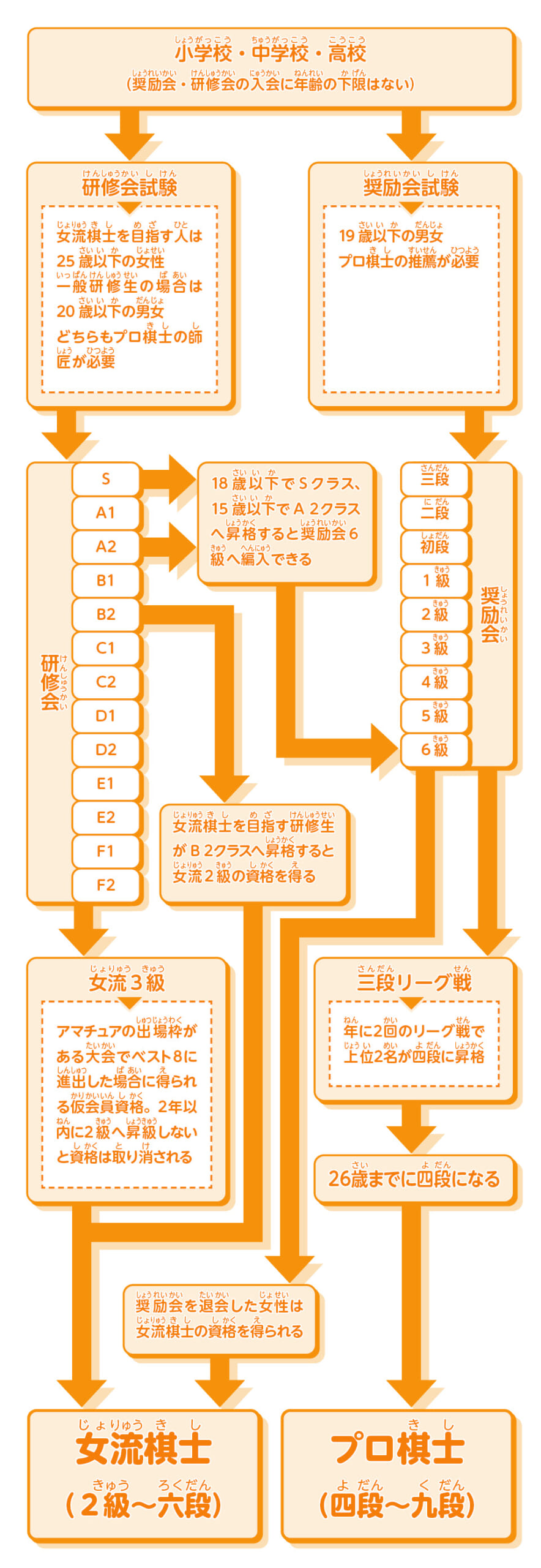
Become a professional by joining an incentive society that trains professional players.
To become a professional Shogi player, one must first join the Shogi Association of Japan, which is the professional Shogi training organization of the Japan Shogi Federation. Not everyone can join the Shogi Association, but you must pass an examination in which you actually play Shogi and win. The examinations are limited to those who are "under 19 years old (for kyu rank)" or "under 22 years old, the winner or runner-up of a national tournament (for dan rank)" and "recommended by a professional professional player". After passing the examination and joining the association, members play games against each other, and their kyu and dan ranks are raised as their results improve. The ranks range from 6-kyu to 3-dan, and at 3-dan, league matches are held twice a year, and the top two players become 4-dan. From 4-dan, one becomes a professional Go player and can participate in "title tournaments" and "general official tournaments. Only four people can become professionals in a year. Furthermore, there is a strict rule that if a player fails to attain Shodan by the age of 21 or Yondan by the age of 26, he or she must resign from the association. Incidentally, Sota Fujii, who holds many records as the youngest professional Go player, became a professional Go player at the age of 14 years and 2 months, when he was in the second grade of junior high school. There are several other ways to become a professional Go player, but all of them have strict conditions, and very few people become a professional Go player in that way.
Women's professional "joryu-kishi" who mainly compete in official women-only tournaments.
The Japan Shogi Federation's "Shorei Association" is open to both men and women. However, as of 2021, no woman has reached the rank of 4-dan in the Shogi Association, and there are no professional "female professionals. However, there is another professional system for women only. It is called "joryu-kishi. To become a joryu-kishi, one must participate in a "training session" held by the Japan Shogi Federation. The target is amateur women under the age of 25 who wish to become Women's Professional Players. If they achieve the required results, they will be promoted to Women's 2nd level. The official professional Women's Go player is Women's 2nd level. Women who have been members of Shorei Association can also become Women's Go players by resigning from Shorei Association. If a woman withdraws from the Women's Association at the rank of 6 kyu or above or 2 kyu or below, she is qualified as a Women's 2 kyu, and if a woman withdraws from the Women's Association at the rank of 1 kyu or above, she is qualified as a Women's Professional Go player with her grade and dan at the time of withdrawal. There are seven title tournaments and one general Women's Go tournament. When not playing games, she participates in study groups to improve her shogi skills and teaches amateurs at shogi classes. She sometimes acts as a "Shogi lady" at Shogi events.
In the Future
Human-to-human chess is more interesting than AI matches.
Sota Fujii, who made his professional debut as a junior high school student, once attracted attention when he played a move that a Shogi AI, which can anticipate several hundred million possible moves, judged to be the best. Shogi is interesting because of such unexpected ideas and dramatic reversals. In a game between a professional player and an AI player, the human player may inadvertently make the worst move and lose the game, but the AI player does not make such human-like mistakes. This is where I feel the infinite possibilities of human beings and their unique strengths and weaknesses. I believe that the number of fans who enjoy the brain games of professionals will not decrease and the job of professional Go players will not disappear. In the future, we can expect that he will make use of his talent and character as a professional Go player, and focus on his main business of playing games and holding events to promote Shogi.
Job Facts
Income.
The main sources of income for professionals and women's professionals are "game fees" paid for participating in games and "prize money" for winning or finishing second. Since it depends on one's ability, as a matter of course, the stronger one is, the more money one earns. Incidentally, the first place in the total amount of annual prize money and game fees for 2020 is 106.45 million yen. Sota Fujii is in fourth place with 45.54 million yen. Some people also earn income from side jobs, such as appearing on TV, commercials, Internet programs and Shogi events, writing essays, and supervising manga.
Vacation?
Professional Go players play about 30 to 40 games a year, which is their main job. 2021 saw the largest number of games played, with Sota Fujii playing 55 games. There are more than 300 days when there are no games, which can be considered a holiday for professionals who play games as their job. However, in most cases, on the days when there are no games, they are doing research to prepare for the next game.
Where do you work?
Game halls, Shogi halls, event halls, Shogi classes, etc.
Your Future Path
It's a chart that shows at a glance the main routes to a professional career!