




certified public accountant
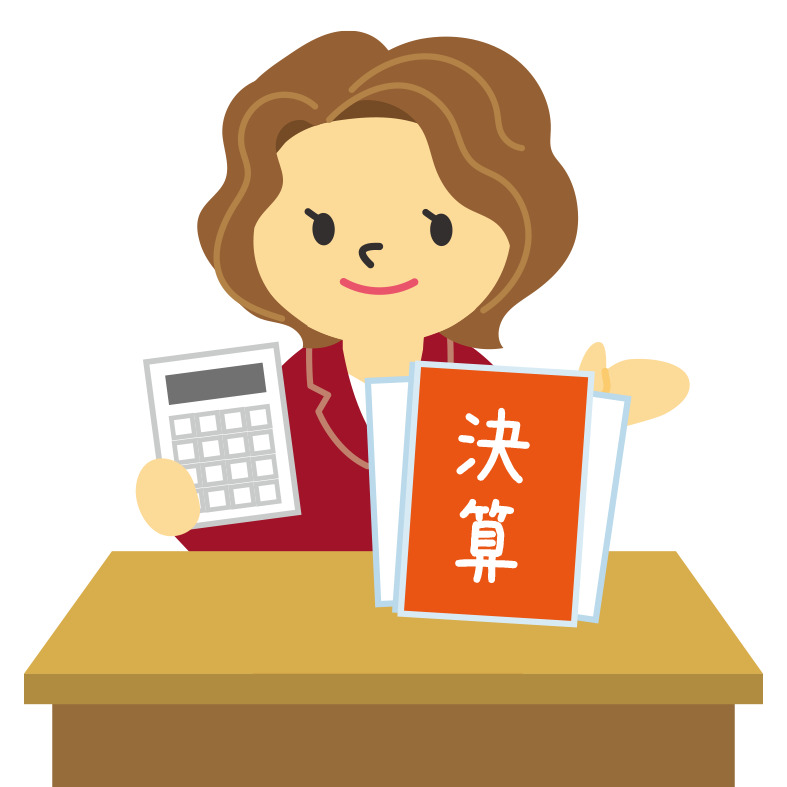
An accounting professional who "checks" and "guides" a company. Their job is to check corporate documents from an impartial standpoint.
Perfect For …
A person who is fair in everything and can judge things calmly. A person who can clearly express his/her opinion without being overwhelmed by the other person's position or age. Since documents lined with numbers are checked, calculation ability and meticulousness are also necessary.
Job Details
Expert in ensuring the reliability of documents showing the company's management status.
A company is required by law to report annually a document called a "financial statement" that summarizes its management status for the year. Financial statements, also called "financial statements" or "financial reports," are like a school report card. For financial institutions and investors, they are important information that helps them decide whether to finance or invest in a company. If there is a mistake or a lie in the contents, not only will the company's credibility be damaged, but it may also cause economic turmoil in society. This is where the CPA, a specialist in ensuring the reliability of financial statements, comes in. The first is "auditing," in which a company's financial statements are checked from a third-party perspective to certify that they are correct. The second is "accounting services," such as guidance on accounting and closing accounts, and the third is "taxation services. The third is "taxation services," in which certified public accountants are registered as tax accountants and can prepare tax documents and provide consultation and advice on taxation matters, etc. The fourth is "consulting services," in which certified public accountants provide consultation and advice on management matters. All of these services require a high level of specialized knowledge and a sense of justice that does not tolerate fraud. CPAs are an indispensable part of capitalist economic activity and have a heavy social responsibility.
Key Points !
It takes a minimum of three years to become a CPA.
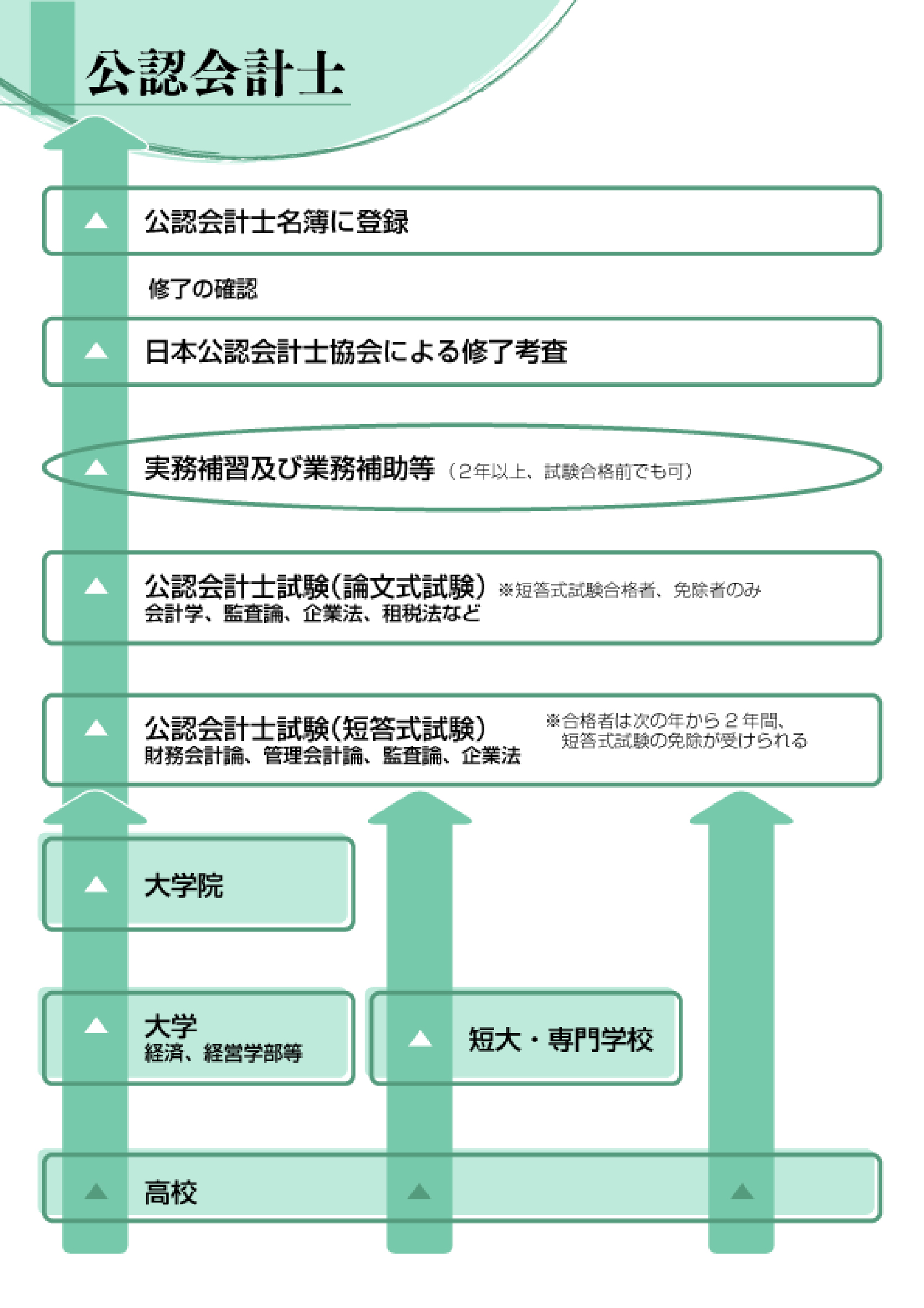
Those who wish to become certified public accountants must first pass the Certified Public Accountant Examination administered by the Certified Public Accountants and Auditing Oversight Board of the Financial Services Agency. There are no specific qualifications, and anyone can take the exam regardless of age, gender, academic background, or nationality. There are two types of examinations, the "Short-Answer Type" and the "Paper Type." Only those who have passed the Short-Answer Type can take the Paper Type examination. Only those who have passed the Short-Answer exam can take the Dissertation exam. If a candidate fails the Dissertation exam, he/she is exempted from taking the Short-Answer exam for the next two years and can take the Dissertation exam. However, even if you pass the CPA examination, you cannot yet call yourself a certified public accountant. The first is to assist a certified public accountant for at least two years; the second is to attend a practical training course for three years at the same time as the practical training course. The third is to pass the "Completion Examination," which is the final examination for the practical training. Once all three requirements have been fulfilled, the candidate can register as a certified public accountant and become a certified public accountant.
CPAs work in a variety of locations
Those who have passed the Certified Public Accountant Examination often work (or change jobs) at an "audit corporation" in order to gain the necessary work experience to be registered on the JICPA's list. An audit corporation is a company consisting of five or more certified public accountants. Although auditing itself can be done by a single CPA, auditing the financial statements of large companies requires a team of CPAs. There are more than 260 auditing firms in Japan, and they are classified into major auditing firms, semi-major auditing firms, and small and medium auditing firms based on the number of certified public accountants belonging to them and the scale of their work. The major audit firms are the four firms that audit more than 100 companies and have more than 1,000 certified public accountants, and are known as the "Big Four. Their performance is overwhelming, so much so that according to 2020 data, 80% of the total annual audit service revenue in Japan is concentrated in the Big 4. Therefore, they are a popular place of employment for CPAs. On the other hand, there are also "in-house accountants" who change jobs from auditing firms and work for general companies or government agencies. Some also become independent and open their own private accounting firms.
In the Future
Increased entrepreneurship and expanded opportunities for activity
If there is a company, there will always be accounting work. Since auditing is essential, it is unlikely that the work of CPAs will decrease, even if it increases. Highly competent CPAs are in great demand. As the number of venture companies in new fields increases, the scope of work for CPAs in auditing them will also expand. On the other hand, it is said that advances in information technology will replace the work of CPAs with AI. It is true that AI may be better at simple calculations and detecting human calculation errors. If the use of IT and AI can be mastered, the time and effort previously spent on simple calculations can be put to good use in other tasks.
Job Facts
Income.
The average annual salary is 5.5-11.6 million yen. For those working at auditing firms, it is about 5-6 million yen for the first year after passing the CPA exam. By the time they reach middle management, their annual income is said to be around 10 million yen. The average annual income for a person who changes jobs from an auditing firm to a venture company is about 7 million yen. Income may also increase if they open an independent office and their work takes off.
Vacation?
It depends on the company you work for, but most audit firms and CPA firms offer weekends off. You can also take paid holidays except when there is an increase in work during the fiscal year closing period or at the end of the fiscal year.
It depends on the company you work for, but if you work for an audit corporation or a private accounting firm, you often have Saturdays and Sundays off. Except during the fiscal year end (March and August) when audit work is concentrated and at the end of the fiscal year when there is an increase in work, you can take paid holidays.
Where do you work?
Auditing firms, private accounting firms, etc. Sometimes spend more time traveling to client companies, etc., to work than working at a desk at the place of work. They often travel on business.
Your Future Path
It's a chart that shows at a glance the main routes to getting a job as a CPA!