




judge
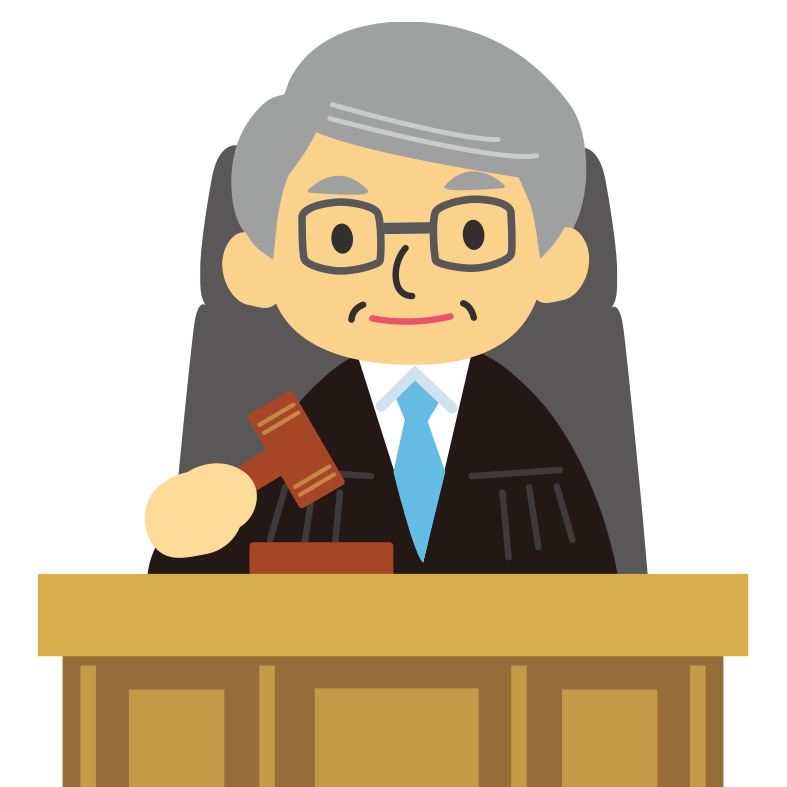
A "judgment professional" who resolves disputes in law. He must assess things impartially from a neutral standpoint.
Perfect For …
A person who can make calm and clear judgments without being misled by the opinions of others. A person who can make an effort to study every day, because in order to make a judgment, it is essential to have a deep knowledge of the law and to compare it with past judgments (precedents).
Job Details
A "keeper of the law" who finds the facts and passes judgment
A judge carefully listens to both the side that sued and the side being sued in a case brought before the court and certifies which side's argument is correct from a neutral and impartial standpoint. The judge's job is then to make an appropriate ruling based on the law, which is called the "guardian of the law. In Japan, there are five types of courts (Supreme Court, High Court, District Court, Family Court, and Summary Court). Most cases are first tried in the "district court," and if the judge is not satisfied with the ruling, the case is tried again in the "high court," and if the judge is still not satisfied with the ruling, the case may be tried again in the "supreme court. This system, which allows a person to be tried three times, is called the "three-trial system" to protect the rights of the person being tried. There are two main types of trials: civil trials and criminal trials. Civil trials are for settling disputes between ordinary people. Criminal trials seek to punish "defendants" accused by prosecutors, who are members of the state, of incidents or accidents. The "family court" is a court that handles "family disputes and juvenile delinquency cases," which are not handled in general civil or criminal trials, and the "summary court" handles civil cases involving a claim of 1.4 million yen or less, criminal cases involving a fine or less, and other minor offenses. In this way, there are various courts, and each judge renders judgments according to his or her own convictions. However, not everyone involved in a court case is satisfied with the verdict. Depending on the verdict, some people's lives may change drastically. The work of a judge is very responsible. For this reason, the work of a judge is a very rewarding job.
Key Points !
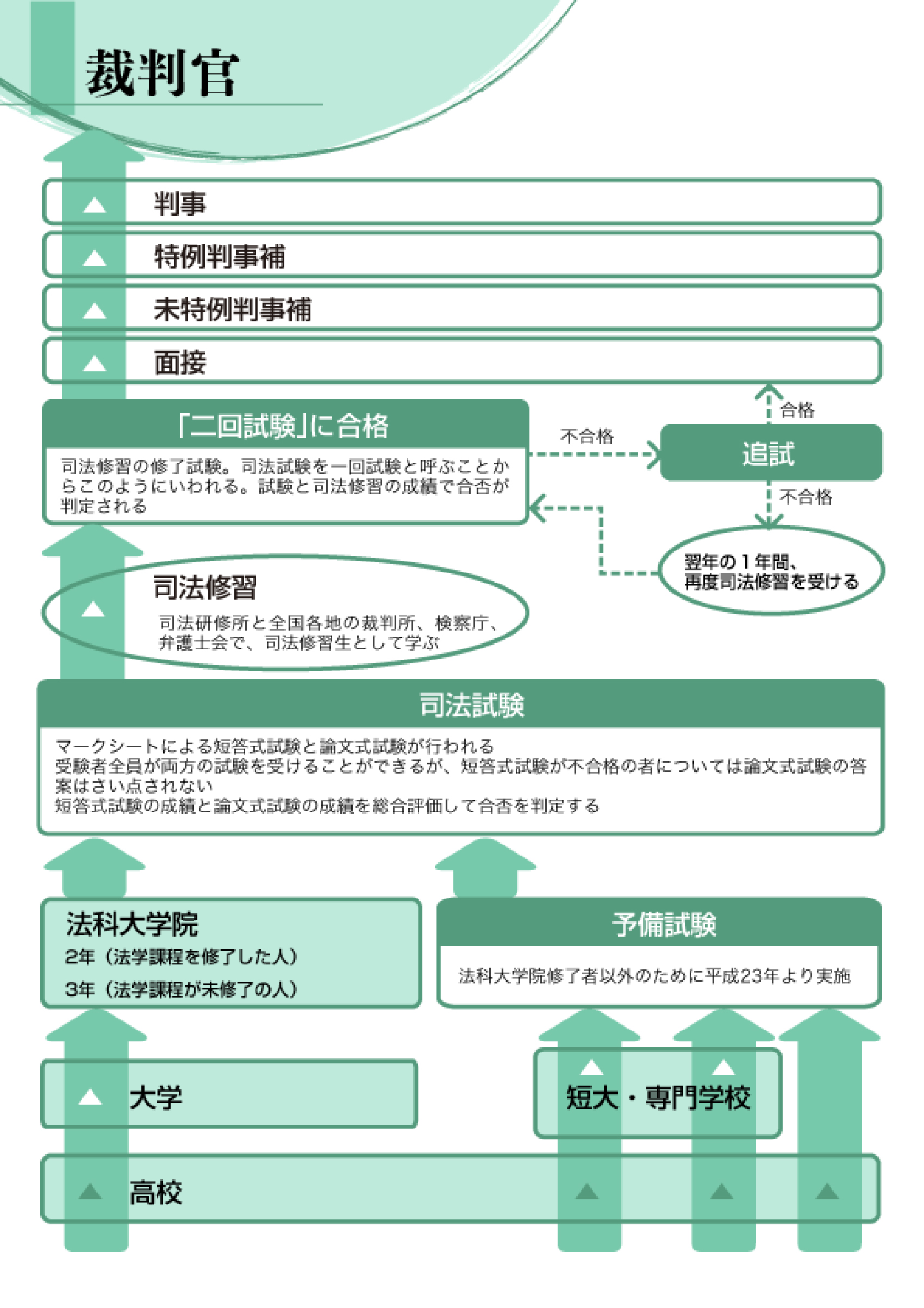
Aiming to pass the bar exam, the most difficult national legal qualification.
To become a judge, one must pass the bar exam, which is a national certification. There is no age limit to take the bar examination, but one must be qualified. To be eligible to take the examination, a university graduate must complete the "Law School" or pass the "National Bar Examination Preliminary Exam. The law school is open not only to graduates of university law departments, but also to graduates of other departments. However, the period of study at the law school is two years for graduates of law schools, but three years for graduates of other faculties. Those who have completed the law school or passed the preliminary examination for the bar exam may take the bar exam as many times as they wish (the exam is held once a year) during a five-year period. The bar exam is said to be the most difficult of the legal national qualifications. Many people use prep schools and correspondence courses, but there are also people who take the test on their own. Beginning in 2023, students currently enrolled in law school will also be able to take the bar exam if they meet certain requirements.
Passing the bar exam doesn't necessarily make you a judge.
After passing the bar exam, the trainee will undergo one year of "legal apprenticeship" at a court, a public prosecutor's office, or a lawyer's office. If they pass the second examination (the legal apprentice examination), which is the final stage of their legal training, they are qualified to become judges, prosecutors, or lawyers. However, it is not always possible to become a judge even if one wishes to do so. Judges are nominated by the Supreme Court and appointed by the Cabinet. In addition to gaining knowledge and experience during their judicial training, they will also need to make an effort to be recognized for their abilities by actively socializing with others. Judges have the title of "judge," and appointed judges are assigned to district and family courts as "assistant judges (unspecified assistant judges). An assistant judge cannot rule alone and cannot preside over a three-judge panel. Some assistant judges with five or more years of experience are appointed by the Supreme Court as "special assistant judges," which gives them the same authority as a judge to render decisions alone. When an assistant judge has more than 10 years of experience, he or she is promoted to the rank of "judge. After 20 years, a judge is assigned to a district court, a family court, or a high court. After 20 years or more, they are assigned to a higher court, where they are assigned to a higher court as chief judge or family court chief judge. The Chief Justice of the Supreme Court, the top judge, is appointed by the Emperor based on a nomination by the Cabinet.
This is the future.
Judges who have experience outside of law and can make warm decisions are needed.
Judges are given particularly strong status protection as "special national public officials" in order to maintain fairness in court proceedings. They have limited grounds for being forced to leave their positions, and their salaries are not reduced. Ranks increase with years of experience, and salaries increase with years of experience. The retirement age is between 65 and 70, so the future is exceptional. On the other hand, judges are transferred to one of the more than 500 court locations in the country approximately every three years. This is to prevent the risk of losing impartiality and neutrality in court proceedings by staying in the same area and getting to know the local people. There is no distinction between men and women, and those who are married and have children are also ordered to transfer, which continues until retirement. Since the term of office for judges is 10 years, some retire without seeking reappointment at the end of their term and change careers to become lawyers or other professionals. In addition, Japan is said to have fewer judges than other countries, and the shortage of judges is still a problem today. In addition to the large number of cases handled by a single judge, internationalization and computerization have resulted in an increase in the variety of cases, and the processing of cases takes time. There are fears that the originally time-consuming trials will become even more protracted. Some people also argue that judges who have never experienced work other than that of a judge will render decisions that are out of tune with the public's perceptions. The "lawyer-appointment system" and the "judge-appointment system" were created to solve these problems. The lawyer-appointment system allows for the appointment of judges with at least 10 years of legal experience. One of the purposes of the jury system is to allow judges selected from among the public to participate in criminal trials and reflect the sensibilities and common sense of ordinary citizens in the trials. In the future, it will be desirable for those who aspire to become judges to gain various experiences outside the law and to be able to make not only cold legal judgments but also warm human judgments.
Job Facts
Income.
The average annual salary is 6.4-14.6 million yen. Salaries for judges, who are national public officials, are set by law: according to data from FY2021, assistant judges are paid approximately 230,000-420,000 yen per month, judges are paid approximately 520,000-180,000 yen per month, and the Chief Justice of the Supreme Court is paid approximately 2,100,000 yen per month. Incidentally, the monthly salaries of the Chief Justice of the Supreme Court and the Prime Minister are the same. In addition, judges do not receive overtime pay, but they do receive bonuses. They can move into inexpensive public employee housing, so they are in quite favorable conditions.
Vacation?
Judges attend their assigned cases in the courtrooms of the courthouse or read and study materials in the judge's chambers. Courtrooms are open Monday through Friday, so they are generally closed on Saturdays and Sundays. However, judges who are busy preparing for trials often proceed with their work at home or at the courthouse even on their days off.
Where do you work?
Supreme Court, High Court, District Court, Family Court, Summary Court.
Your Future Path
It's a chart that shows at a glance the main routes to getting a job as a judge!