





fire official
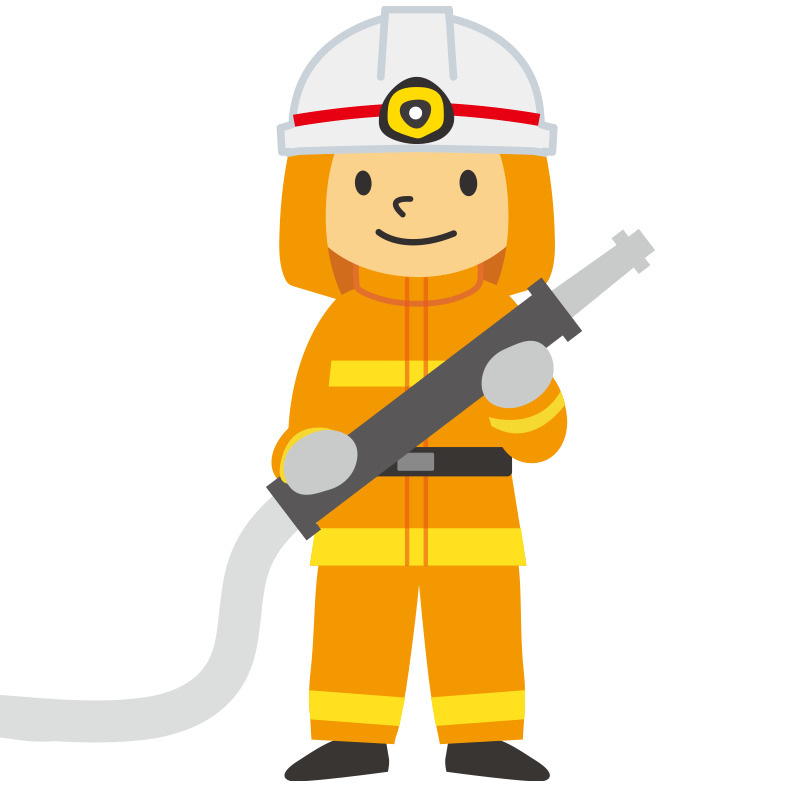
In addition to fires, they rush to the scene of accidents, earthquakes, typhoons, and various other disasters to save lives!
Perfect For …
Because the work involves human life, it requires courage and a strong sense of responsibility to overcome difficulties and carry through to the end. They also need to be calm and able to cooperate with others. Above all, they must be physically strong.
Job Details
Rushing to the scene of a fire or accident to protect people's lives and property
Firefighters stand by at fire stations on a 24-hour shift, and when they receive a 119 call, they rush to the scene to protect people's lives and property. There are four major types of firefighting duties: firefighting, emergency medical services, rescue, and disaster prevention. In firefighting, firefighters rush to the scene of a fire in a fire truck and extinguish the fire by spraying water from a pump truck or other means. In the "emergency medical services," a three-member ambulance team rushes to the scene of an accident to provide first aid to the sick or injured and transport them to a hospital. Rescue" involves rescuing people who have failed to escape or are trapped under a collapsed building at the scene of a disaster or accident. There are "rescue teams (special rescue teams)" with specialized knowledge and skills in lifesaving activities and "hyper rescue teams (special advanced rescue teams)" equipped with special vehicles. In regions with mountains and oceans, "mountain rescue teams" and "water rescue teams" are deployed. Firefighting and disaster prevention helicopters are deployed to rescue people in distress, and firefighting boats are deployed to extinguish fires on ships and port facilities. Disaster Prevention inspects buildings and fire extinguishing equipment and provides guidance in disaster drills in order to prevent fires and reduce the damage caused by natural disasters. It is also the job of firefighters belonging to the Prevention Division to investigate the causes of fires to assist in firefighting and disaster prevention activities. When not on duty, firefighters perform clerical work, maintain and inspect vehicles and equipment, and conduct firefighting and rescue training in the fire station where they are on standby.
Key Points !
Pass employment examinations conducted by each municipality.
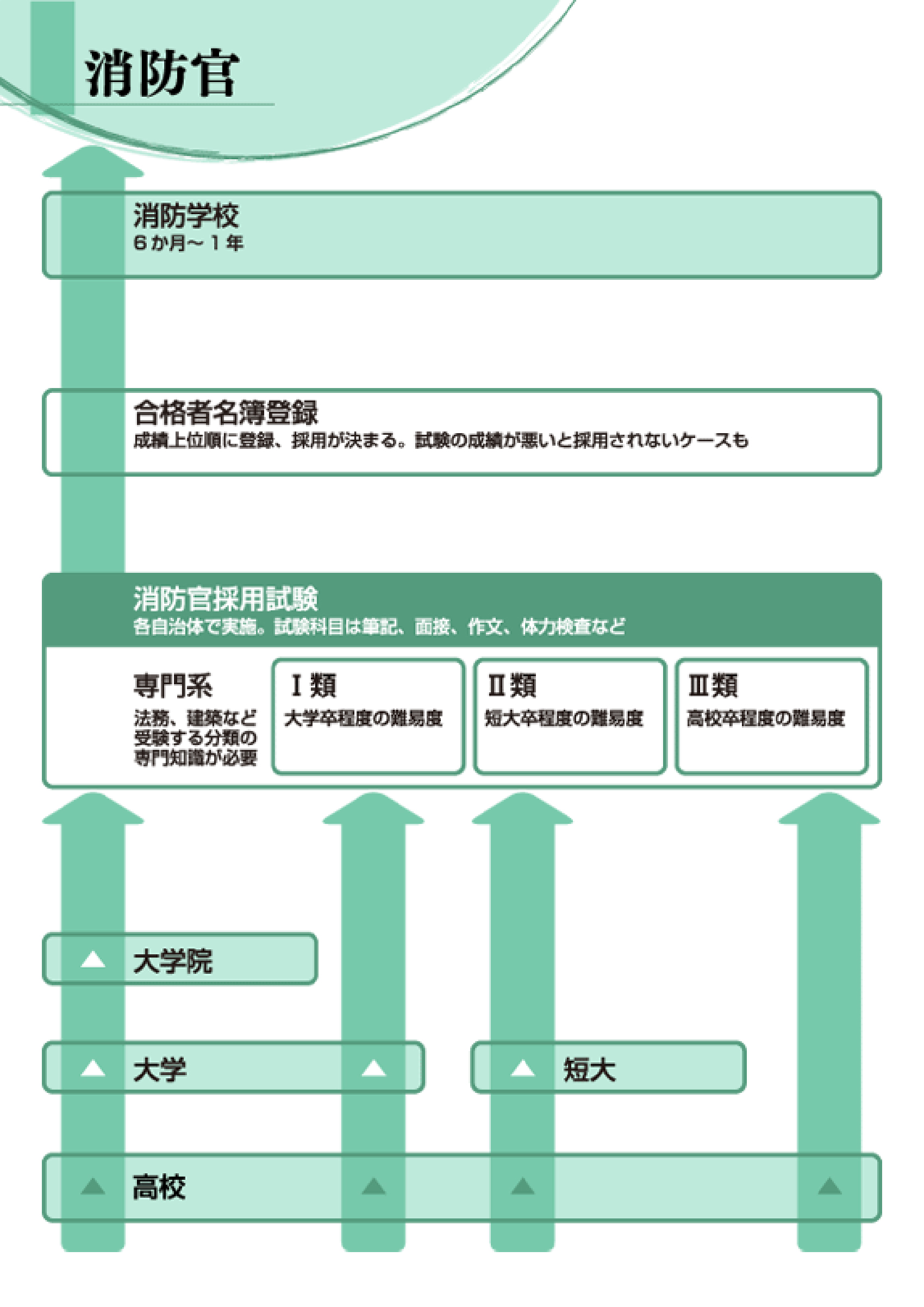
Firefighters are local public servants who work at the "fire department headquarters" established by municipalities and other local governments throughout Japan. Those who wish to become firefighters must graduate from high school, junior college, or university, and then pass an employment examination administered by the fire department. Note that qualifications for the examination differ from municipality to municipality. In the case of the Tokyo Fire Department, there are four types of qualifications: "Class I" for university graduates aged 22 to 30; "Class II" for junior college graduates aged 20 to 30; "Class III" for high school graduates aged 18 to 22; and "Specialized" for university graduates aged 22 to 30 with expertise in law, architecture, electricity, etc. There are four types of examinations: "Specialized" for university graduates between the ages of 22 and 30 with specialized knowledge in law, architecture, electricity, etc. The examinations include not only a written test of the basic academic skills required to work as a public official, but also a physical examination and physical fitness tests such as a 1km run, repeated horizontal jump, and push-ups. Those who wish to become firefighters should be physically fit on a regular basis. In addition, the popularity of civil servants with stable income is high, and the ratio of applicants for firefighter recruitment examinations is high. In the case of the Tokyo Fire Department's Class III recruitment examination for FY2021, 5,889 people took the exam and only 231 passed. The multiple was 20.3. The Tokyo Fire Department has a particularly high ratio of applicants, but the ratio is also high in local areas where the number of applicants is small. If you are not confident about taking the exam on your own, it is a good idea to study at a civil service examination prep school.
Once hired, students receive basic firefighting training at the fire academy.
After passing the employment examination and being hired by the fire department, they are appointed as firefighters. However, they do not immediately go into action at the scene of a fire. New firefighters, both male and female, are enrolled in a boarding school in each prefecture and some cities for their initial training. The duration of this training is approximately six months. They learn the rules and regulations they must follow as firefighters, as well as basic knowledge and skills related to firefighting and disaster prevention, and develop the muscular strength and stamina to withstand firefighting work. Once they graduate from the fire academy and are assigned to a fire station, they are ready for duty. At first, both men and women are engaged in firefighting using pump trucks. Since they do not learn a specialized course in "first aid" during their initial education, they are not allowed to ride in ambulances. Those who wish to become paramedics must again attend a fire academy for approximately two months to complete a specialized course in "first aid" and become qualified as "first aid standard course graduates" before being allowed to ride in an ambulance. If you have more than five years or 2,000 hours of practical experience in emergency activities as a paramedic and more than one year of study at a paramedic training school, you will be qualified to take the national exam to become a "first-aider paramedic. Conversely, a person with paramedic certification may become a firefighter. However, even if they are certified as paramedics, as firefighters, they are also engaged in firefighting activities. In addition, those who wish to become rescue personnel undergo approximately one month of training at a fire academy. There is also an institution called the "Fire Academy" where they receive even more advanced education and training.
In the Future
Preventing damage to the elderly and increasing the number of female firefighters.
In 2021, there were 35,077 fires. That is approximately 96 fires per day, or one fire every 15 minutes. Firefighters are the ones who put out these fires day and night. The work of firefighters in protecting the safety of daily life will never cease. The largest number of deaths from fire occur in building fires, and approximately 70% of the fatalities are elderly people. In Japan's super-aging society, protecting the elderly from fires is an issue that cannot wait. In addition, it is expected that the number of times the elderly are transported by ambulance will increase. As of April 2021, female firefighters accounted for about 3.2% of all firefighters. The government is conducting public relations activities to encourage female firefighters to become more active. On the other hand, Japan is one of the most earthquake-prone countries in the world, and there is always the danger of major fires that could occur as a secondary disaster to a massive earthquake. Furthermore, global warming has increased the strength of typhoons and flood damage. In order to minimize such damage, it is imperative to create disaster-resistant cities, and firefighters have an important role to play in providing disaster prevention guidance to residents.
Job Facts
Income.
The average annual salary is 6.35 million yen. Since it is a local public employee, it is not uniform throughout the country, but is subject to the salary regulations of each municipality. The basic salary is approximately 300,000 yen, the same amount as other civil servants, but with the addition of various allowances totaling approximately 100,000 yen, the total monthly salary is approximately 400,000 yen. The allowances unique to firefighters include a "special duty allowance (approx. 7,000 yen)" for work in dangerous places, an "overtime allowance (approx. 20,000 yen)," a "night work allowance (approx. 5,000 yen)," and a "holiday work allowance (approx. 12,000 yen). Incidentally, new firefighters are also paid during their initial training period at the fire academy.
Vacation?
There are three types of work schedules for firefighters: "daily shift," "second shift," and "third shift," and which one is adopted depends on the fire department. In the "daily shift," firefighters work eight hours a day, Monday through Friday, from morning to evening, just like ordinary civil servants, and their days off are Saturdays, Sundays, and national holidays. In the "two-shift system," two groups of firefighters work 24 hours each, repeating work and off-duty (rest days after switching shifts) two or three times, with two consecutive days off in the middle of the shift. There are eight vacation days in four weeks. In the "3-shift system," three groups work 24 hours each, basically repeating work, off-duty, and holidays several times, with one day of daily work and two days off in the middle of the shift. There are six days off every three weeks. Incidentally, the 24-hour workday does not, of course, mean working 24 hours straight. From 10:00 p.m. to 6:00 a.m. the next morning, the workers take a nap or otherwise rest for approximately eight hours. Before and after that, they work 16 hours for two days, for a total of 24 hours. To be precise, it is not so much working hours as time spent waiting at the fire station in preparation for a dispatch.
Where do you work?
The fire department of each municipality, such as a city, town, or village, receives a 119 call and rushes to the scene of work to extinguish fires, provide emergency medical services, or perform rescue operations. In the event of a large-scale disaster, the fire department may go to other cities, towns, and villages to provide support if requested.
Your Future Path
It's a chart that shows at a glance the main routes to getting a job as a firefighter!
Let's take a look at what firefighters actually do!
A closer look at the work of firefighters in the Yokohama Fire Department!