




politician
As representatives of the people, they have the important job of making laws and ordinances that rule social life, and of determining the budgets of the national and local governments. A sense of responsibility and a desire to improve people's lives are required.
Perfect For …
People who have ideas to improve society and have the drive to make them a reality. People who can listen to different opinions and improve their own. A person who likes to work for the benefit of others. I want you to be such an honorable person who can always work for everyone's happiness, without thinking about your own interests or profit and loss.
Job Details
Realizing people's needs through Congress
Politics is the system of thinking about how to improve the country and people's lives, and then carrying it out. A politician is a person who makes politics a profession or a political activity such as electioneering a profession. Among politicians, those who run for election and are elected are called "senators," who are members of the legislature. There are two types of legislators: those involved in national politics are members of the Diet, and those involved in prefectural and municipal politics are members of local assemblies. One of the roles of the Diet and local assemblies is to make, change, or eliminate laws, ordinances, and other rules. The job of council members is to listen to the needs of the people and propose new rules to the assembly for the benefit of the people, and to consider agenda items such as rule amendments and vote for or against them. Another important job of council members is to consider and vote on the budgets needed to run the national and local governments. As politicians who have won the confidence of many people in elections, lawmakers bear the heavy responsibility of realizing the desires of the people through the decisions they make in the Diet. In particular, politicians are required to have a high level of expertise and the ability to make appropriate decisions in response to a mountain of important issues, both domestically and internationally.
Key Points !
Age and money needed to run for election
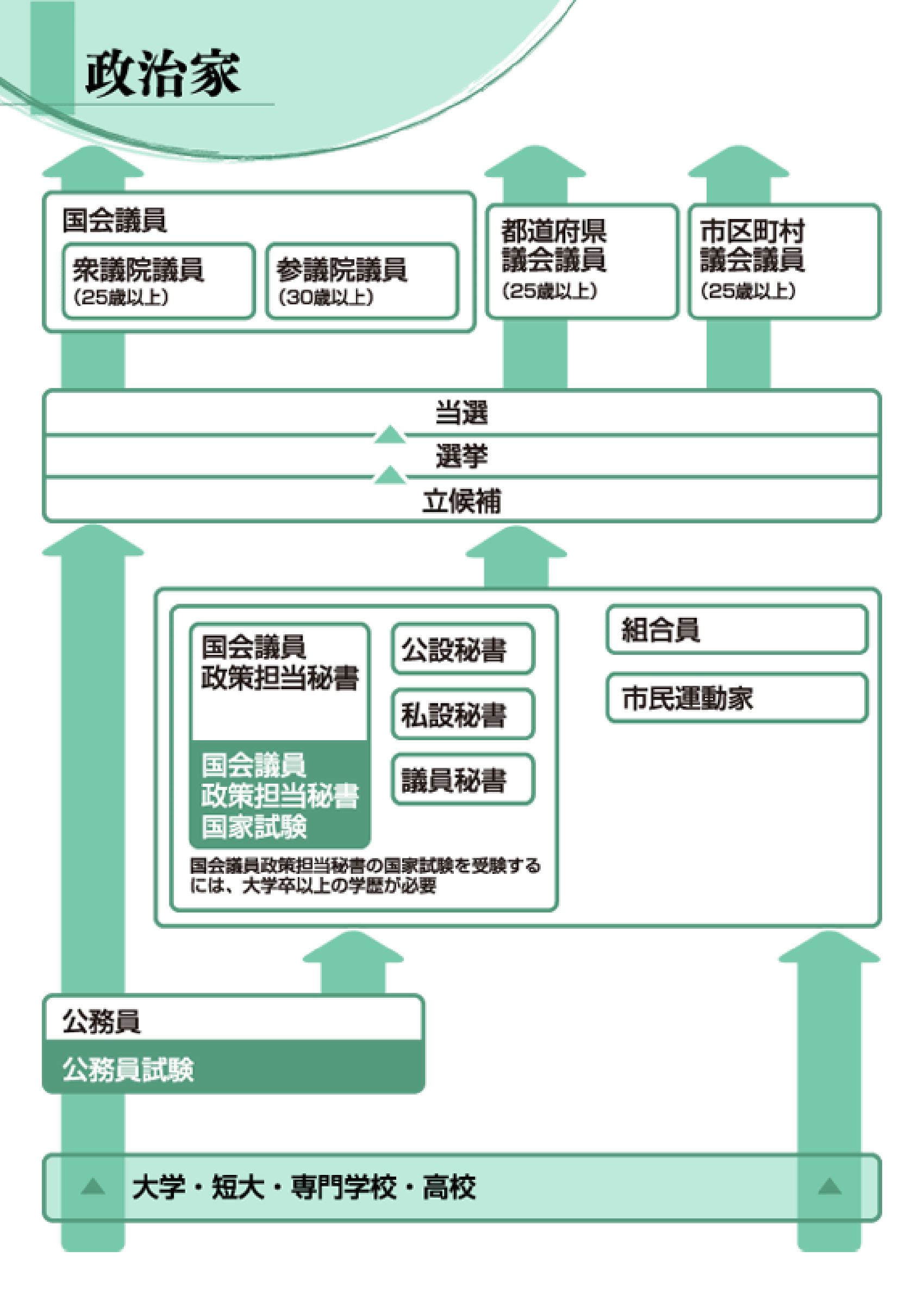
Anyone can be a politician in the broad sense of the word, but to become a member of Congress, one must run for election and win. There are several conditions that an individual must meet in order to be eligible for election. First, the person must be a Japanese citizen with Japanese nationality. Once a Japanese citizen reaches 18 years of age or older, he or she is granted the right to vote, which is the right to choose a representative for everyone in an election. Then, when they reach a set age (qualifying age, which varies depending on the type of election), they are given the "right to be elected," which is the right to run for office in elections. The qualifying age for each election is 25 years or older for members of the House of Representatives and 30 years or older for members of the House of Councillors, and 25 years or older for members of prefectural and municipal assemblies. Incidentally, prefectural governors are at least 30 years old, and mayors of municipalities are at least 25 years old. However, those who have committed a crime may lose the right to vote or be elected, depending on the type of crime and the length of the sentence. In addition, money is required to run for office. In addition to campaign expenses, a "deposit" is made to the Legal Affairs Bureau. This system is designed to prevent candidates who have little chance of being elected from running for office for the fun of it, and to prevent publicity stunts through elections. If a certain number of votes are obtained, the money is returned, but if the number of votes does not reach the specified number or if a candidate withdraws his or her candidacy after paying the deposit, the full amount of the deposit or a certain amount is taken away. The amount of the deposit varies depending on the election, ranging from 150,000 yen for municipal council elections to 6 million yen for proportional representation elections for the House of Representatives and the House of Councillors.
Learn about politics by joining a political academy or becoming a senator's secretary.
There are no special qualifications to become a politician. There is no academic background required, and there are no specialized schools. However, since the work of a politician involves making laws and ordinances and the administration of policies in accordance with laws, it is advisable to go to a university's law, economics, or political science department to learn specialized knowledge. Although not a school, there are "political academies" aimed at training politicians. There are various types, including those run by political parties, public interest foundations, and individuals. Graduating from a juku does not guarantee that one will become a politician (legislator), but it may be a stepping stone on the stairway to becoming a politician. Some people who aim to become Diet members after winning elections first become secretaries to Diet members and help them with their work, thereby developing their skills as politicians. In particular, secretaries in charge of policy affairs who assist Diet members in formulating policy can study political activities firsthand as they participate in the process of making laws by gathering materials and summarizing the main points of legislation. The National Qualification Examination for Diet Members' Secretaries in Charge of Policy-Making is a national qualification that is required for this job, so it is a good idea to take it up.
In the Future
Young politicians in their 20s and 30s are expected to be active.
Dissatisfaction with government policies and lack of explanation to the public has led to public distrust of politics. In the future, politicians with integrity and passion will be in high demand, whom the public can trust. In addition, many young people do not participate in elections. One of the reasons for this is that policies aimed at the older generation are prominent, and the younger generation is not interested in them. However, in order to gather the voices of many people and reflect them in the Diet, the strength and flexible ideas of young people are indispensable. Another problem is that the percentage of female Diet members in Japan remains low by international standards. In order to make the most of women's unique perspectives, it is hoped that an equal number of women and men will be elected to the Diet. On the other hand, unfortunately, there are not many men and women who want to become politicians. In order to send the few competent and trustworthy politicians to Congress, it will become more important for voters to have a discerning eye for politicians and to vote for them in elections.
Job Facts
Income.
The annual salary of Diet members who do not hold office is 1,294,000 yen per month (as of 2022). This is supplemented twice a year by a year-end allowance, amounting to approximately 22 million yen per year. In addition, 12,000,000 yen is paid for research, research, public relations, and accommodation expenses.
In addition, the legislators receive a monthly allowance of 12,000,000 yen (1,000,000 yen per month for 12 months) and a monthly allowance of 7,800,000 yen (650,000 yen per month for 12 months) for legislative affairs, for a total annual amount of approximately 42 million yen. Despite the fact that the expenses are covered by taxes paid by the public, there are problems, such as the fact that third parties cannot confirm the use of either the research and public relations stay expenses or the legislative affairs expenses, and some have called for a review of the high annual expenses. In addition, the annual expenses for prefectural and municipal assembly members vary from municipality to municipality. Incidentally, the research and study expenses paid monthly to local assembly members are called "political activity expenses.
Vacation?
It is not enough to attend the congress; it is difficult to take personal time to hold study meetings with other congressmen and politicians, attend meetings with supporters, and so on. Especially during the election period, they have to work almost sleepless nights and nights, running around the campaign area.
Where do you work?
In the case of members of the Diet, examination and deliberation take place in the plenary halls and committee rooms of the National Diet Building. They are also given offices in the House of Representatives and the House of Councillors, where they hear petitions and appeals from the people. Local assembly members also attend local assemblies to deliberate and vote on bills. During the election period, they work out their campaign plans in their election offices.
Your Future Path
It's a chart that shows at a glance the main routes to a political career!