

Japanese maritime safety officer

The diver who was in the spotlight in the movie "Umizaru" is also a coast guard officer! Many people aspire to be a "marine policeman.
Perfect For …
Working in the harsh natural environment of the ocean requires, above all, physical strength. They must also have the energy to endure the hard training required to do so. They also need to be calm and not panic in any situation, and have a sense of justice and responsibility as "marine police officers. Since the work is often done in groups, it is also important to be able to follow the rules and cooperate with others.
Job Details
Interdiction of maritime crime, maritime rescue, safety management, etc.
A coast guard officer is a national public officer belonging to the Japan Coast Guard. They are involved in a variety of tasks to protect the safe and beautiful oceans. The first job is to interdict smuggling, stowaways, and other maritime crimes, and to perform rescue operations in the event of natural disasters and accidents. Removing oil spilled into the sea as a result of ship-to-ship accidents is also an important job. The second job is to survey the topography of the seafloor, water depths, currents, etc., and provide information and make nautical charts. The third job is to install and maintain lighthouses and other navigational markers (marine signposts), which are indispensable for safe ship travel, and to organize traffic on the sea.
Here is the point!
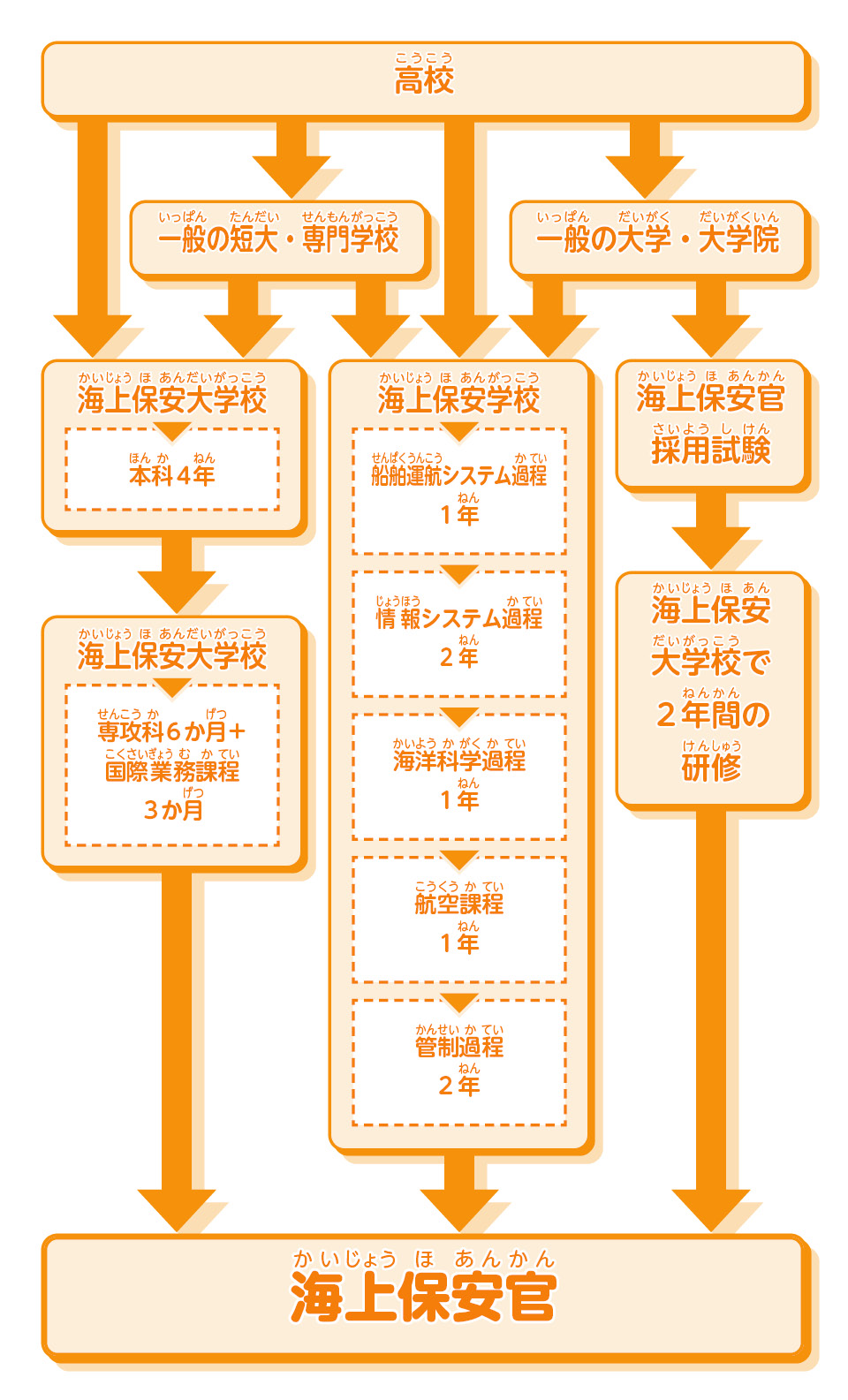
First, enter the Coast Guard's educational institutions.
To become a Coast Guard officer, one must first enter a Coast Guard educational institution. For the employment examination, you must choose one of the five educational courses. The examination is held in one of five educational courses, including the ship operation system course, the aviation course, or other courses. The educational institution is a boarding school, where students learn a variety of specialized knowledge and skills to become a marine specialist. The employment examination includes a written test and a physical examination.
If you want to become an officer, go to the Japan Coast Guard Academy
The Japan Coast Guard Academy is an educational institution that trains future officers. The educational period is four years and nine months. Upon graduation, students are awarded Japan's only bachelor's degree (coast guard). Upon graduation, the graduates are assigned to patrol vessels throughout Japan as entry-level officers.
In the Future
The role of Japan's maritime zone is becoming increasingly important in a situation that is threatening Japan's maritime zone.
Tensions with neighboring countries have increased, and Japan's sovereignty in the sea area is now threatened as neighboring countries move into Japan's waters. The future of the situation is unpredictable. Smuggling and illegal voyages are on the rise, and maritime accidents could happen at any time. The job of protecting safety and order on the sea is becoming more and more important, and the role of coast guard officers is sure to grow heavier accordingly. Depending on the individual's desire and aptitude, there are training programs to become specialists such as "international investigators," "special rescue teams," and "divers," who can intervene in cases of smuggling and stowaways.
Job Facts
Income.
Since Coast Guard officers are national public servants, their basic salary is determined by law. It varies according to age, educational background, and rank, and includes various allowances depending on the nature of the work. For example, a graduate of a national security academy and an assistant officer on a large patrol vessel earns approximately 250,000 yen per month, while a graduate of a national security college and a chief officer on a large patrol vessel earns approximately 260,000 yen per month. Students of educational institutions also receive a monthly salary of about 140,000 yen because they are national public servants (employees of the Japan Coast Guard).
Vacation?
Patrol boat duty is based on a four-week period with eight days off. The workday is 8 hours a day, but patrols are conducted 24 hours a day, so many times you will sleep on the boat while taking turns. Be prepared to work long hours in the event of an incident or accident.
Where do you work?
13 jurisdictional headquarters and other locations throughout the country.
Your Future Path
It's a chart that shows at a glance the main routes to a job in the Coast Guard!