




licensed tax accountant
The tax system is complex and difficult to understand. We are a taxpayer's ally who provides consultation and handles procedures on behalf of taxpayers.
Perfect For …
A person who can keep up a steady effort. The job provides many opportunities to work on detailed trial calculations, so you must be the type of person who "doesn't have a hard time with calculations" to be able to do the job. Also, since it is important to have a relationship of trust with customers, sociability and honesty are necessary. It is also important to be "tight-lipped" and able to keep secrets.
Job Details
Assisting taxpayers and business owners as tax and accounting professionals
A tax accountant is a specialist in "taxes," which are money that citizens must pay to the national government and local governments (prefectures, cities, wards, towns, and villages). Taxes are collected from the public to cover the cost of public services provided by the national and local governments, such as school education, medical care and welfare, and police and firefighting activities. Taxes are divided into national taxes (e.g., income tax), which are paid to the national government, and local taxes (e.g., inhabitant tax), which are paid to local public entities. Local governments determine the amount of local taxes, while national taxpayers are required to calculate the amount of taxes to be paid by themselves, prepare a document called a "tax return," file it with the tax office, and pay the tax. The taxation process is complicated and difficult to understand, as the method of calculation differs for each type of tax. It is tax accountants who perform such tax work on behalf of taxpayers. Therefore, the main jobs of licensed tax accountants are to prepare tax returns at the request of taxpayers (individuals, stores, and companies), file tax returns and pay taxes on their behalf, and provide tax-related consultation. These three tasks are permitted only to licensed tax accountants by law. In addition, since certified tax accountants are also specialists in accounting, they prepare "financial statements," which report on the financial condition of a company, and provide guidance and consultation on accounting. Tax accountants, who use their expertise to help people, have an important job of supporting the nation's finances through taxation.
Key Points !
The exam to become a licensed tax accountant requires eligibility to take the exam.
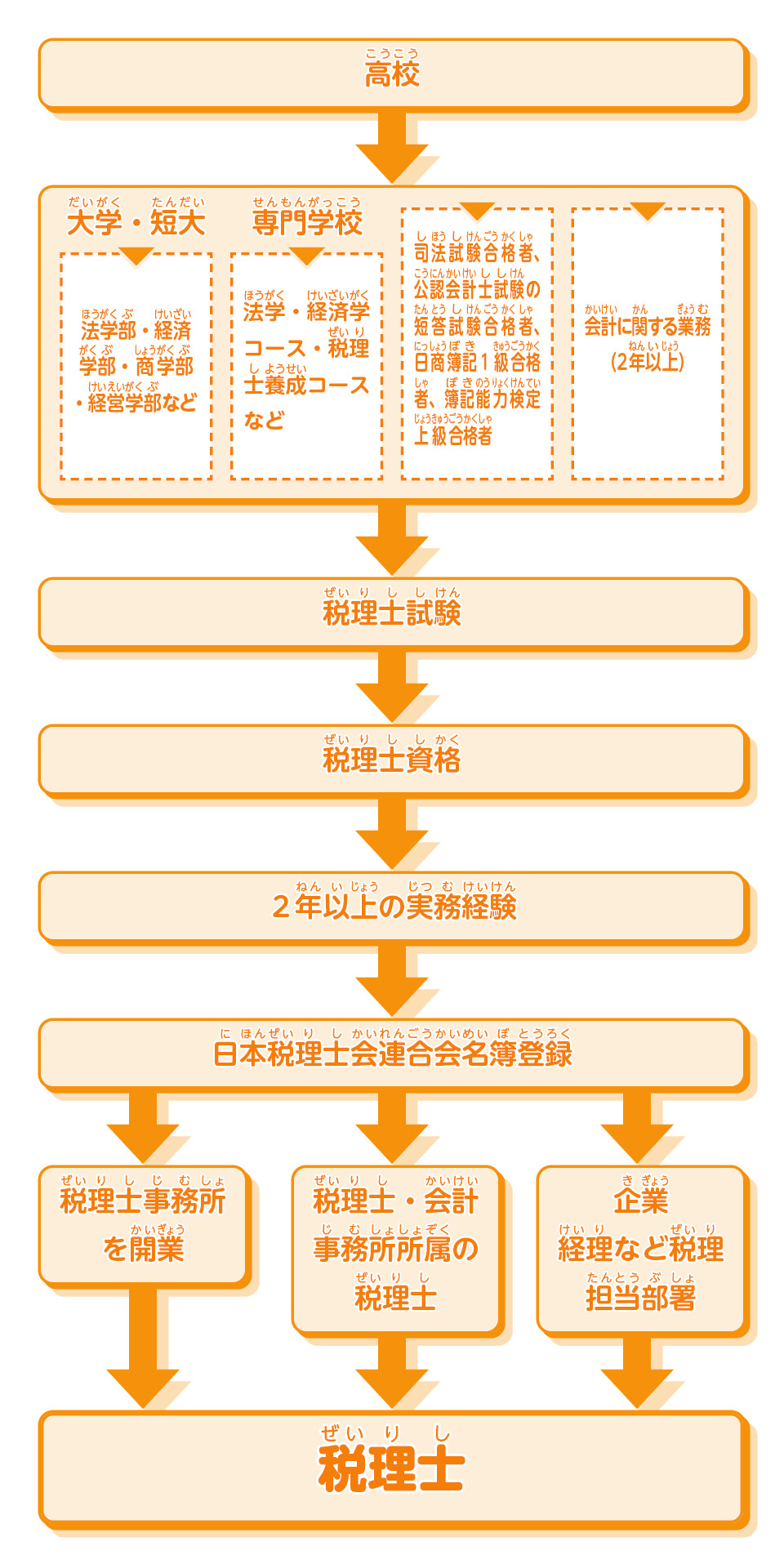
A certified tax accountant is a job that requires national certification. To become a certified tax accountant, one must pass the "Certified Public Tax Accountant Examination," a national examination. However, the Certified Public Tax Accountant Examination is not open to all, and one must meet the requirements for "academic knowledge," "qualifications," and "work experience" in order to take the exam. For example, there are five academic requirements, including "those who have graduated from a university, junior college, or technical college and have studied at least one subject in law or economics. Similarly, there are two conditions for qualifications and three conditions for work experience. By fulfilling any one of these conditions, a person is qualified to take the exam. For this reason, it is common for those who aspire to become certified tax accountants to go on to study law, economics, business administration, or commerce at university before taking the Certified Public Tax Accountant exam. Incidentally, high school graduates cannot meet the academic requirement. However, the requirements for qualifications, "those who have passed the Nissho Bookkeeping Examination Level 1" and "those who have passed the Advanced Level of the Full Experience Bookkeeping Examination," are exam qualifications that can be obtained by high school graduates as well. In addition, one of the requirements for work experience, "those who have been engaged for two years or more in supplementary clerical work at a tax accountant's office or other business," would also be a qualification that high school graduates could obtain to take the examination. In other cases, the National Tax Council's individual certification may also qualify a person to sit for the exam. However, passing the Certified Public Tax Accountant examination does not immediately make one a Certified Public Tax Accountant. You cannot call yourself a certified tax accountant without registering with the Japan Federation of Certified Public Tax Accountants' Associations, and to register with them, you need "at least two years of work experience at a certified tax accountant's office or accounting firm. Since the period of work experience can be before or after the Certified Public Tax Accountant exam, many people first work at a Certified Public Tax Accountant office or the like and challenge the Certified Public Tax Accountant exam while gaining work experience. Thus, becoming a certified tax accountant is a very difficult and long road. That is why the work of a certified tax accountant, who acts on behalf of taxpayers, carries such a heavy social responsibility.
The tax exam can be approached with a "long-term plan".
The tax accountant examination, which is held once a year, tests knowledge of accounting and tax law. There are 11 subjects on the exam: two "accounting subjects" and nine "tax law subjects. The Certified Public Tax Accountant examination is based on the "subject pass system," meaning that examinees choose their subjects, and if they pass five of them, they have passed the Certified Public Tax Accountant examination. Incidentally, since the examinee must choose both accounting subjects, he or she must choose three of the nine tax law subjects. However, it is not necessary to take five subjects at once in one examination. The subjects you pass are valid for the rest of your life, so you can take the exam one subject each year, accumulating passes, and passing five subjects over several years is all that is required. Apart from that, there are cases in which the Certified Public Tax Accountant exam can be waived. One method is to enter graduate school and obtain a degree by writing a thesis on tax law or accounting, and then apply to the National Tax Council for exemption from the subject tests. If the application is approved, one subject in accounting and two subjects in tax law will be exempted. In addition, those who have worked at a tax office for a certain period of time are exempted from some of the subjects of the Certified Public Tax Accountant examination. In particular, those who have worked for the tax office for 23 years or more and have completed the designated training program are exempt from all subjects of the Certified Public Tax Accountant examination. In addition, certified public accountants, lawyers, and those who have passed the bar exam and completed legal training can register as certified tax accountants without taking the certified tax accountant exam.
In the Future
Will AI be left to do the paperwork and tax accountants focus on advice?
Since it is difficult to start one's own business immediately after being registered as a certified tax accountant, many people gain experience by working for a certified tax accountant's office or other firm. The busiest time for such licensed tax accountants is from mid-February to mid-March. This is the season when individuals calculate income tax on money earned from business and consumption tax to be paid by store owners, and submit their tax returns to the tax office for payment. However, nowadays, tax returns can be easily prepared and submitted to the tax office via the Internet. In addition, the performance of computer tax and accounting software has also improved, making it possible to process tax returns without the assistance of a tax accountant. In the future, such clerical work as the preparation of tax documents will increasingly be left to AI. The work of tax accountants is expected to focus on humanistic and intellectual services that cannot be handled by AI, such as giving advice on business management while taking into account the client's requests and sentiments, and using their knowledge and experience as tax specialists.
Job Facts
Income.
The average annual salary ranges from 5.5 to 11.6 million yen. If you belong to a tax accountant/accounting firm, it depends on the firm. Some people earn more than 20 million yen a year if they start their own business and get on track.
Vacation?
Although weekends and holidays are my day off, I often have meetings with clients and socialize with them, which can often disrupt my days off. The months of February and March, when tax returns are filed, May and November, when companies close their books, are extremely busy.
Where do you work?
Tax accountant firms, CPA firms, accounting departments of general companies, etc.
Your Future Path
It's a chart that shows at a glance the main routes to getting a job as a tax attorney!