


How fast does the earth rotate?
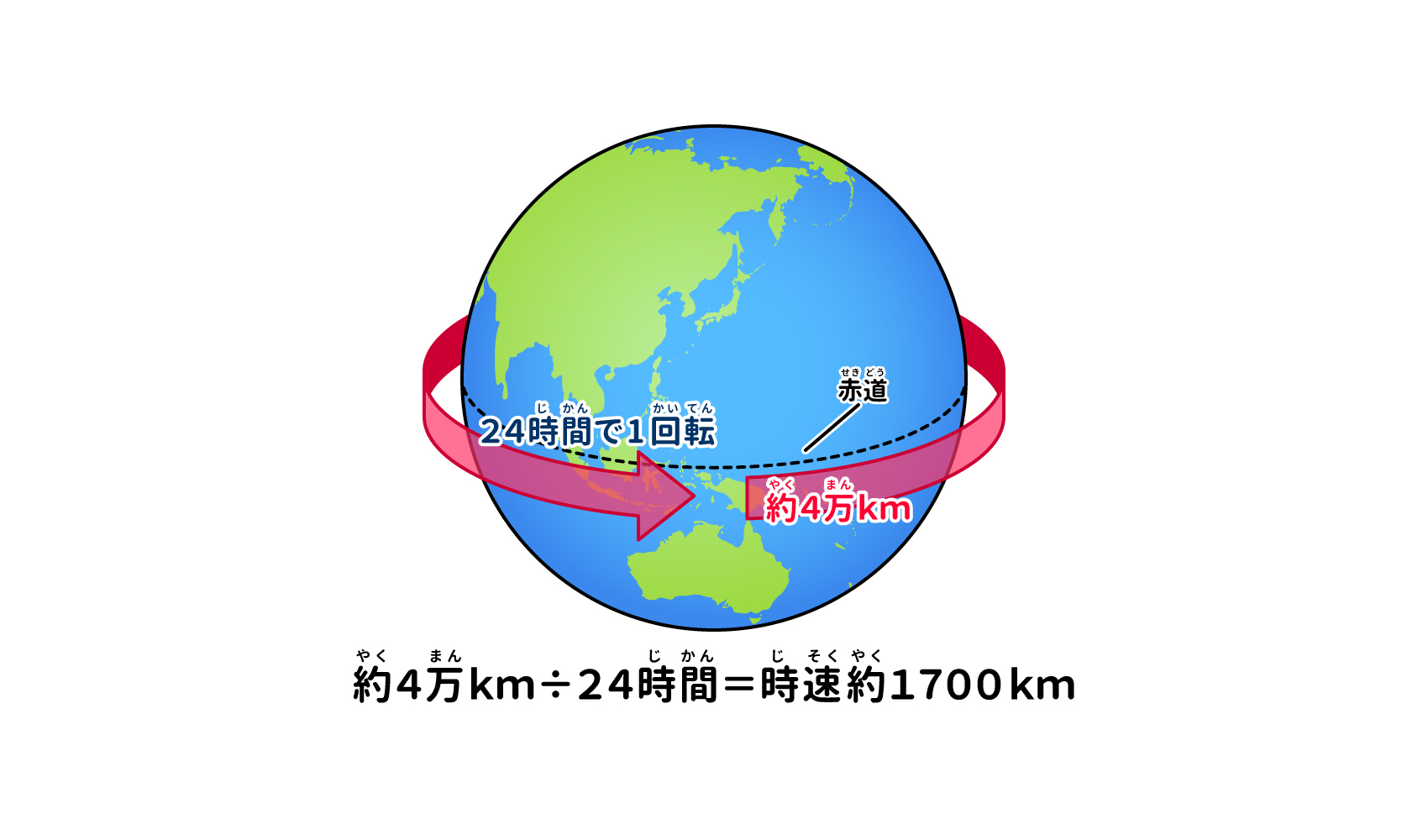
Answer: It turns at a speed of about 1,700 km per hour.
Find the speed of a place on the earth based on the distance it moves in a day due to its rotation. The earth rotates once a day. Since the length of the earth's equator is about 40,000 km, a point on the equator moves about 40,000 km in 24 hours (related article: "How long is one revolution of the earth?"). (See also the article "How Long is a Circumnavigation of the Earth? This can be expressed in terms of the speed per hour: approx. 40,000 ÷ 24 = approx. 1,700, i.e., the speed of rotation on the equator (rotation speed) is approx. 1,700 km/h.
Let us compare the speeds of the E5 (Hayabusa) and E6 (Komachi) running on the Tohoku Shinkansen with those of familiar objects. The E5 Series (Hayabusa) and E6 Series (Komachi) running on the Tohoku Shinkansen have a top speed of 320 km/h1) and the cruising speed (most efficient speed) of a Boeing 787 jet is 916 km/h2). This means that the earth's rotation speed is more than five times faster than that of a bullet train and about twice that of a jet plane.
It may be easier to visualize the speed of the earth's rotation if we convert it to the speed of the earth's rotation in minutes and seconds. 1 hour is 60 minutes, so 40,000 ÷ 24 ÷ 60 = about 28, or about 28 km per minute. 1 minute is 60 seconds, so 40,000 ÷ 24 ÷ 60 ÷ 60 = about 0.46, or about 460 meters per second. Since sound travels through air at a speed of about 340 meters per second, the earth's rotation speed is faster than sound.
It is strange that we do not feel the speed of the earth even though it is spinning so fast. This is because we on the earth and the air around us are moving at the same speed as the earth.
So far we have looked at the rotation speed at the equator, but let us also check the rotation speed in Japan. If the latitude of Japan is 35°N, the rotation speed is about 1374 km/h. Compared to points on the equator, the distance traveled in a day is shorter, so the speed of rotation is a little slower.
The speed of the earth's rotation is said to have changed over time.3) The length of a day is 24 hours, which was determined based on the average length of a day for about 100 years in the 19th century. Around 1990, however, it took about 2 milliseconds (one millisecond is one thousandth of a second) longer than 24 hours for the earth to make one rotation.
So, is the Earth's rotation speed slowing down? Studies have shown that this is not necessarily the case. 2003 observations of the Earth's rotation showed that each rotation took about 1 millisecond longer than 24 hours, meaning that the Earth was spinning faster in 2003 than it did in 1990. In other words, the rotation was faster in 2003 than it was around 1990.
Thus, the speed of the earth's rotation changes over a long period of time. Therefore, scientists add a second, called a leap second, at the end of December 31 or June 30 to adjust the time deviation.
Article published: December 2021
reference data
1) JR East Japan "Tohoku Shinkansen": https://www.jreast.co.jp/train/shinkan/tohoku.html
(2) Japan Airlines "Boeing 787-8 (788)/In-flight Seating Configuration": https://www.jal.co.jp/jp/ja/aircraft/conf/787.html
(3) National Astronomical Observatory of Japan, "Is the Length of the Day Changing?":https://www.nao.ac.jp/faq/a0404.html
Supervisor: Mitsuharu Oyama

Born in Tokyo in 1957. Completed a master's degree at Tokyo Institute of Technology. After working as a physics teacher at a high school, a chief instructor at Chiba Prefectural Board of Education, and principal of Chiba Prefectural Chousei High School, he is currently a professor at Shumei University School Teachers' College, where he teaches lectures and exercises on teaching methods for "Science and Mathematics Exploration" and "Integrated Learning Time". He has appeared in many science experiment classes and TV experiment programs. He is also a project advisor for the Chiba City Science Museum, an executive director of the Japanese Society of Physics Education, a member of the Japanese Society for Science Education and the Japanese Society for Science Education, and a member of the editorial board of the monthly magazine "Science Education.