





How is glass made?
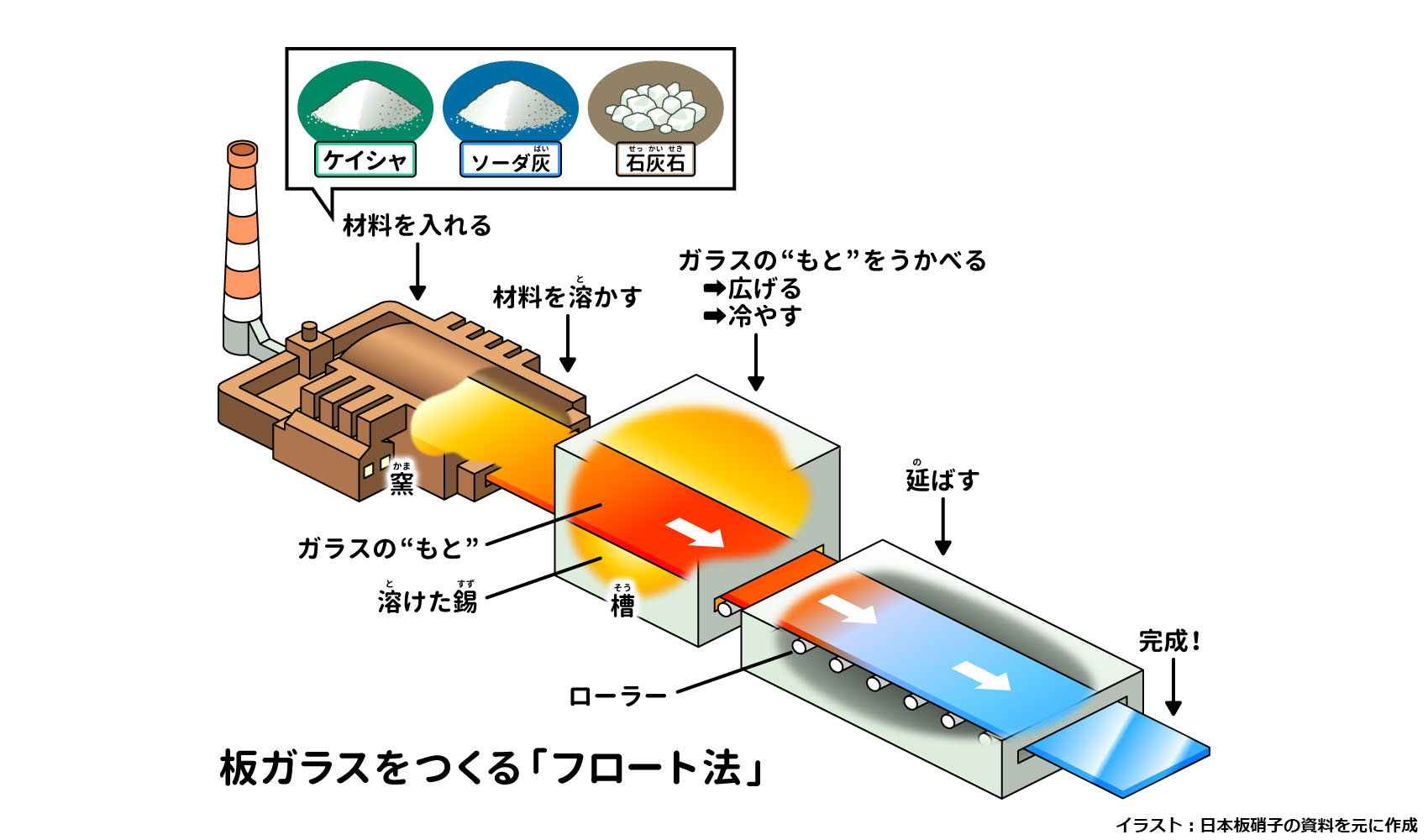
Answer: The ingredients are melted to a sludge at a high temperature and then cooled to harden.
Glass is made by melting Keisha, soda ash, and limestone in a cauldron at 1,500-1,600°C and then drawing it out (see related article "What is glass made of?"). (Related article: "What is glass made of?"). Have you ever seen a craftsman making bottles or other objects by attaching a syrupy "base" of glass to the end of a pipe and gasping for breath? This is a method called "hand-blown glass" that has been used since the 1st century B.C. *1). This handmade method cannot produce the large quantities of glass (industrial glass) that are needed at one time. Therefore, in the 20th century, a number of methods were devised to produce glass in large quantities using machines.
One of these methods is the "float method," which is the standard method for making plate glass used for windows and TV screens*2). In this process, the "base" of the glass, which is still red hot, is placed in a large tank in which a metal called tin is melted. The glass is spread flat, cooled, and hardened, and then drawn out and stretched with a roller conveyor to produce flat glass of uniform thickness and width.
Another method is the "roll-out method," which produces screened glass and molded glass. In this method, the melted glass "base" is inserted between two rolls from the top and bottom and stretched to form sheet glass. Before the rolls are inserted, a wire mesh is combined with the glass, and the mesh glass comes out of the rolls as mesh glass.
To make bottles, the glass "base" is first made into small chunks and poured into molds (metal molds that do not melt even at high temperatures) to form the original shape of the bottle*3). Then, a rod-shaped mold is used to shape the bottle into a wide-mouthed bottle, or high-pressure air is used to inflate the bottle to form a narrow-mouthed bottle.
In this way, glass of various sizes and shapes can be made by combining a number of materials and using a construction method that suits the purpose.
By the way, why is glass transparent?
Keisha, the main material used to make glass, is a highly transparent mineral that does not absorb light. However, that is not the only reason why glass is transparent.
When a glass material is melted, the boundary between particles disappears. When the melted material is cooled, it solidifies while the molecules are neither liquid nor solid (this state is called the "glassy state "*4). 4) This allows light entering the material to pass through without being scattered, making the glass appear transparent.
reference data
(1) Japan Glassware Industry, "The Beginning of Glass
http://www.glassman.or.jp/know_01.html
2 ) AGC, "Flat Glass Manufacturing and Processing Methods," General Catalogue of Flat Glass Building Materials, Technical Data Edition.
https://www.asahiglassplaza.net/catalogue/
(3) Toyo Glass, "How Glass Bottles are Made"
https://www.toyo-glass.co.jp/making_process/
(4) High Energy Accelerator Research Organization (KEK), "[KEK Essay #6] Chiko Knows! Why Glass is Transparent"
Supervisor: Mitsuharu Oyama

Born in Tokyo in 1957. Completed a master's degree at Tokyo Institute of Technology. After working as a physics teacher at a high school, a chief instructor at Chiba Prefectural Board of Education, and principal of Chiba Prefectural Chousei High School, he is currently a professor at Shumei University School Teachers' College, where he teaches lectures and exercises on teaching methods for "Science and Mathematics Exploration" and "Integrated Learning Time". He has appeared in many science experiment classes and TV experiment programs. He is also a project advisor for the Chiba City Science Museum, an executive director of the Japanese Society of Physics Education, a member of the Japanese Society for Science Education and the Japanese Society for Science Education, and a member of the editorial board of the monthly magazine "Science Education.