





What is an "Electricity Supply-Demand Stress Alert?
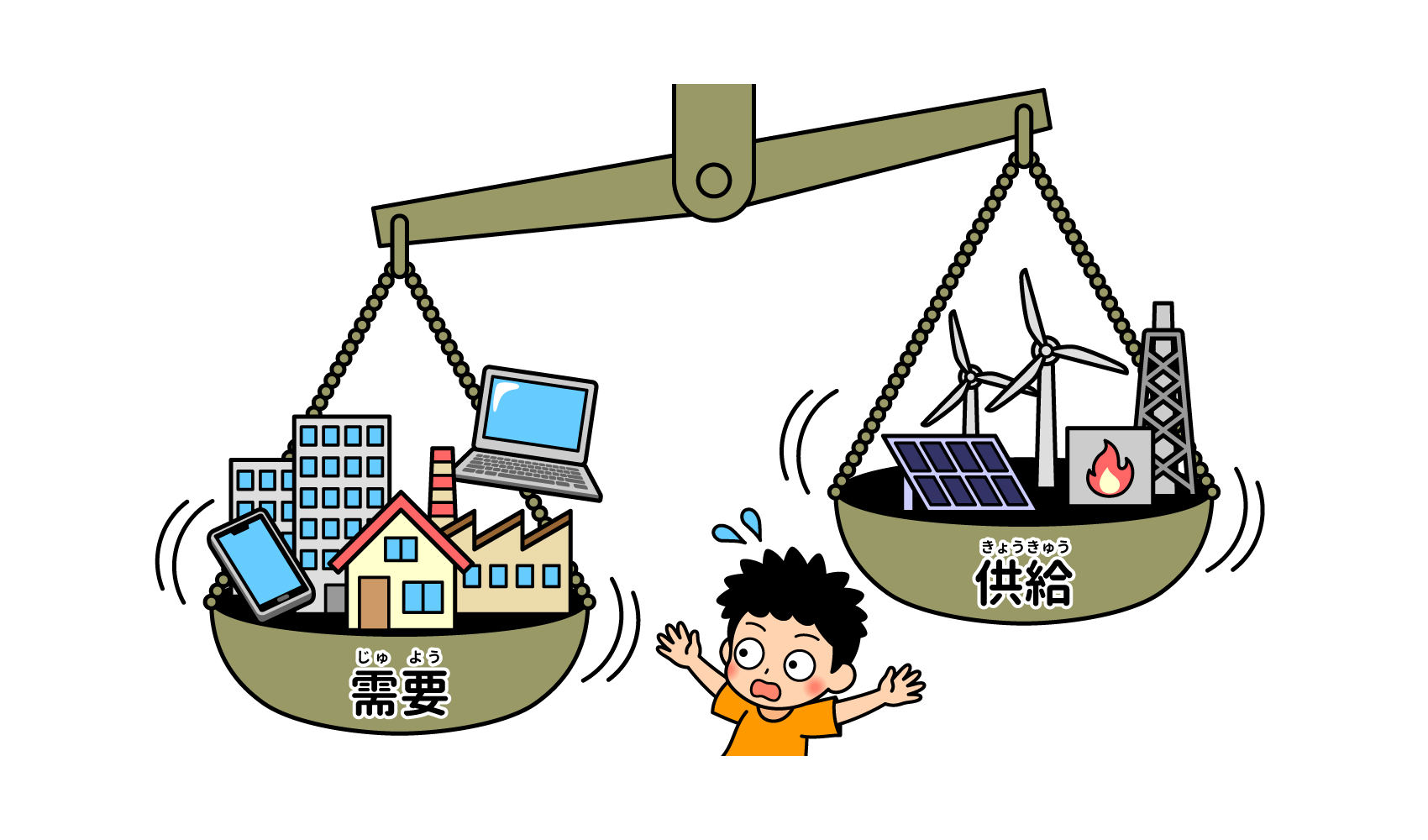
Answer: It is a warning that tells people that there may not be enough electricity that can be sent from power plants and encourages them to conserve electricity.
The sound of "power supply urgency" has an alarming atmosphere, even if one does not understand the meaning of the word. Even if you don't understand the meaning of the word, the sound of "power-supply-impending crisis" may make you feel alarmed. What does the "electricity supply-demand crunch warning" actually tell us?
First, let's break down the term "electricity supply-demand crunch alert. The word "power" refers to the work (energy) done per second by electricity. Supply and demand" is a contraction of the words "demand" and "supply," so the supply and demand of electricity refers to the electricity we want to use and the electricity that can be sent from power plants. And "supply and demand" is the state of not being able to afford it. In other words, a "power supply-demand crunch" is a situation in which the balance between supply and demand is out of balance, and there is no more room to spare in the amount of power that can be supplied. When this situation occurs, the Agency for Natural Resources and Energy issues an "electricity supply-demand crunch warning" to alert the public that there is a possibility that the amount of electricity that can be supplied may not be sufficient to meet demand.
Next, let's consider what kind of situation is defined as an "imbalance between supply and demand of electric power. Electric power companies determine the amount of electricity to be generated by forecasting the maximum demand (peak) in advance.1) The greatest demand for electricity during the year occurs in summer, when the temperature is high and air conditioning is used a lot. Demand is particularly high during the daytime, when temperatures are high and many factory machines are in operation. Since demand for electricity varies depending on the weather, power companies constantly adjust the amount of electricity generated to meet fluctuating demand. However, a sudden increase in demand or a sudden shutdown of a power plant due to an earthquake, for example, can cause a major disruption in the supply-demand balance. In such cases, electric power companies respond by suspending (blacking out) a certain amount of power transmission.
Of course, electric power companies have prepared measures to ensure stable electricity delivery without causing blackouts. That is the "reserve ratio" of electricity. The amount of electricity generated is set by adding some margin to the forecasted peak demand. Since the demand for electricity can increase or decrease by about 3% relative to the forecast, a reserve ratio of at least 3% is required.
When there is a risk that supply capacity will not be sufficient even with this reserve ratio, an "Electricity Supply-Demand Stress Alert" is issued. The Agency for Natural Resources and Energy forecasts electricity demand for the following day based on meteorological information and data from electric power companies. When the reserve ratio is likely to fall below 5% by around 4:00 p.m., the Agency issues an "electricity supply-demand crunch warning" 2). 2) If the outlook is more severe and the reserve ratio is likely to fall below 3%, an "Electricity Supply-Demand Stress Warning" is issued.
When an "Electricity Supply-Demand Stress Alert" or "Electricity Supply-Demand Stress Warning" is issued, we should proactively help save electricity by turning off lights and changing air conditioner temperature settings. It is also important to take energy-saving actions not only when a warning is issued, but also on a regular basis (see related article, "What should I do when an 'electricity supply-demand crunch warning' is issued?) (Related article: "What should I do when there is a power supply/demand crunch warning?
When the supply-demand balance of electricity is disturbed and the output (supply) of generators becomes insufficient, the frequency of electricity flowing through power lines (50 Hz in eastern Japan and 60 Hz in western Japan) drops. Since there is a risk of large-scale power outages if the frequency continues to drop, the power company's system automatically stops transmitting a certain amount of power when it detects a drop in frequency3),4).
Article published: August 2022
reference data
(1) Agency for Natural Resources and Energy, "What is the electricity supply-demand balance, a keyword for stable electricity supply? Let's experience it through a game": https://www.enecho.meti.go.jp/about/special/johoteikyo/balance_game.html
(2) Agency for Natural Resources and Energy, "Electricity Supply and Demand Measures," June 30, 2022: https: //www.meti.go.jp/shingikai/enecho/denryoku_gas/denryoku_gas/pdf/051_03_01.pdf
(3) Agency for Natural Resources and Energy, "Why did the Tokyo area experience power outages on February 13? ~Why did areas far from the epicenter experience power outages?": https://www.enecho.meti.go.jp/about/special/johoteikyo/why_teiden.html
(4) Tokyo Electric Power Grid, "Demand and Supply Balance," Electricity Forecast: https: //www.tepco.co.jp/forecast/html/ufr-j.html
Supervisor: Mitsuharu Oyama

Born in Tokyo in 1957. Completed a master's degree at Tokyo Institute of Technology. After working as a physics teacher at a high school, a chief instructor at Chiba Prefectural Board of Education, and principal of Chiba Prefectural Chousei High School, he is currently a professor at Shumei University School Teachers' College, where he teaches lectures and exercises on teaching methods for "Science and Mathematics Exploration" and "Integrated Learning Time". He has appeared in many science experiment classes and TV experiment programs. He is also a project advisor for the Chiba City Science Museum, an executive director of the Japanese Society of Physics Education, a member of the Japanese Society for Science Education and the Japanese Society for Science Education, and a member of the editorial board of the monthly magazine "Science Education.