


How does lightning strike?
Answer: Strong light and loud noise are produced when electricity accumulated in clouds is released to the earth's surface.
Lightning is electricity generated in cumulonimbus clouds (cumulonimbus clouds). Normally, the air surrounding clouds is impervious to electricity, but when a large amount of electricity accumulates in a cloud that cannot be contained, the electricity travels through the air to the ground surface. This phenomenon of electricity being discharged from the cloud to the earth's surface is called a "lightning strike.
So why does electricity occur in clouds? How does the electricity travel through the air to the ground? Let's take a step-by-step look at how electricity is generated in clouds.
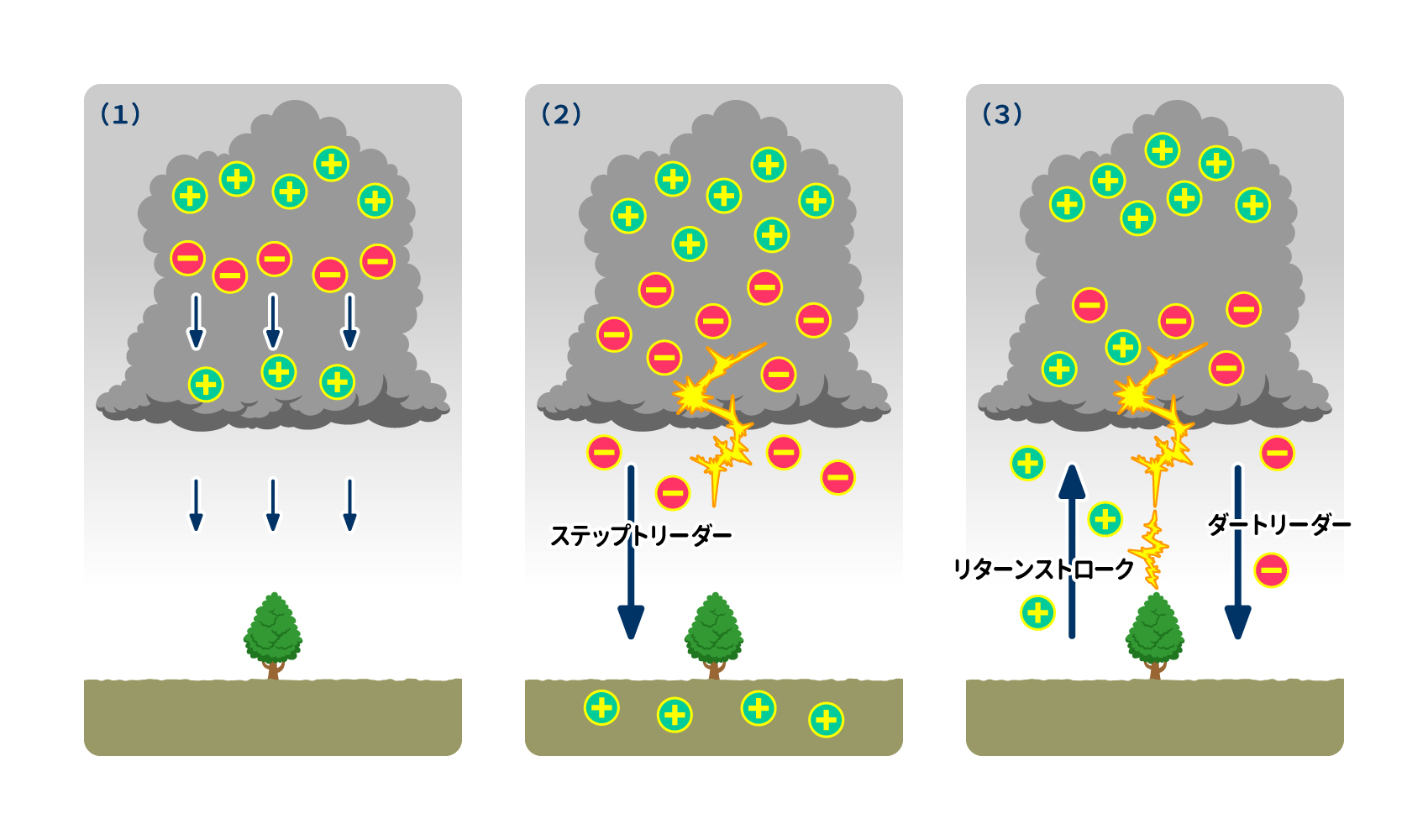
(1) Electricity is generated in clouds and is divided into "+" (positive) and "-" (negative).
Clouds are made up of tiny droplets of water, or "cloudbursts," and ice crystals (see related article, "What Are Clouds Made Of and How Are They Formed?) Clouds are made up of small water "cloud particles" and ice crystals "ice crystals. When a cloud develops into a cumulonimbus cloud, ice crystals increase in number and move violently up and down together with the air, causing the ice crystals to collide with each other, which results in an electrical charge (this is called "electric charge "1). This is called an electric charge1).
When electricity accumulates, a tripolar structure of +, -, and + is formed in the higher layers of the cloud. In the cloud, the "-" charges in the middle layer move downward to eliminate the "+" charges in an attempt to eliminate this charge concentration ("neutralization").2) The "-" charges then move further down, toward the ground surface. The "-" charge then moves further down, toward the earth's surface.
(2) Able to "step-tread" to find the path of the charge
Because air does not conduct electricity well, electricity does not move forward all at once. Instead, it moves forward, stops, and then moves forward again, stopping again to find an easier path through the air. This is called "step leader" (step-type precursory discharge).
When the stepto-reader travels about 50 meters, it stops for 30 microseconds to 90 microseconds (0.00003 to 0.00009 seconds) and then proceeds again.3) The average velocity of the stepto-reader is about 150 km/second. Since the average speed is about 150 km/second, when the cloud height is about 3000 m above the ground, it takes about 0.02 seconds for the stepto-reader to approach the ground.
(3) Neutralize the clouds by "going back and forth" of electric charges.
When the stepto-leader reaches near the ground surface, the tip of the stepto-leader connects with the discharge from the ground surface, causing a "return stroke" (return lightning strike) in which positive electricity flows all the way from the ground to the clouds. This set of stepto-leader and return stroke is one lightning strike. The luminescence of the electrical path is the "lightning flash" or "lightning bolt," and the vibration of the air caused by the heat of the thunder is the "thunderclap" (see related article "Why does lightning shine in a zigzag pattern?"Why does thunder rumble? (See "The World's Most Popular Cities").
However, a single "back and forth" between the step leader and return stroke may not be sufficient to neutralize the charge in the cloud. In this case, the discharge begins again from the cloud toward the ground.
In this second discharge, the "-" electricity goes to the surface at once because the path of electricity has already been created. This is called a "dirt leader" (arrow-shaped precursor discharge). When the dirt leader reaches the earth's surface, another return stroke occurs. Although each lightning strike lasts from 0.5 to 1 second, the "back and forth" of electricity occurs on average 3 to 4 times, and in many cases more than 10 times.
As the term "lightning strikes" suggests, we have an image of lightning "falling" from the sky to the earth's surface. In reality, however, some lightning strikes from below to above.
Lightning can be divided into the following four types4).
(1) Lightning discharging from a "-" charge in a cloud toward a "+" charged ground surface (up to down)
(2) Lightning discharging from a "+" charge on the ground toward a "-" charge in the cloud (down to up)
(iii) Lightning discharging from a "+" charge high up or at the bottom of a cloud and moving toward the "-" charged ground surface (up to down).
(4) Lightning discharging from a "-" charge on the ground toward a "+" charge high in the clouds (down to up)
(1) accounts for about 90% of summer lightning strikes. On the other hand, lightning strikes (2), (3), and (4) are more common in winter. Lightning (2) is often seen in tall buildings such as steel towers, windmills, and skyscrapers, as well as in mountainous areas.
Article published: April 2022
reference data
(1) Kentaro Araki and Sayaka Tsuda, "Kodomo no Kagaku Kagaku Science Books NEXT: Let's learn the relationship between Kumon weather and predict the future! It will be fun to look at the sky! How Clouds Work".January 2022. Seibundo Shinkosha
(2) Franklin Japan, "Knowledge of Lightning," "What is Lightning?" : https: //www.franklinjapan.jp/raiburari/knowledge/lightning/37/
(3) Otowa Electric Industry, "Technical Information: Key Points of Lightning Protection Lightning Discharge Phenomena": https://www.otowadenki.co.jp/basic4/
(4) Kobayashi, Fumiaki, "Lightning". June 2020. Seizando Shoten
Supervisor: Mitsuharu Oyama
Born in Tokyo in 1957. Completed a master's degree at Tokyo Institute of Technology. After working as a physics teacher at a high school, a chief instructor at Chiba Prefectural Board of Education, and principal of Chiba Prefectural Chousei High School, he is currently a professor at Shumei University School Teachers' College, where he teaches lectures and exercises on teaching methods for "Science and Mathematics Exploration" and "Integrated Learning Time". He has appeared in many science experiment classes and TV experiment programs. He is also a project advisor for the Chiba City Science Museum, an executive director of the Japanese Society of Physics Education, a member of the Japanese Society for Science Education and the Japanese Society for Science Education, and a member of the editorial board of the monthly magazine "Science Education.