


Why does lightning shine in a zigzag pattern?
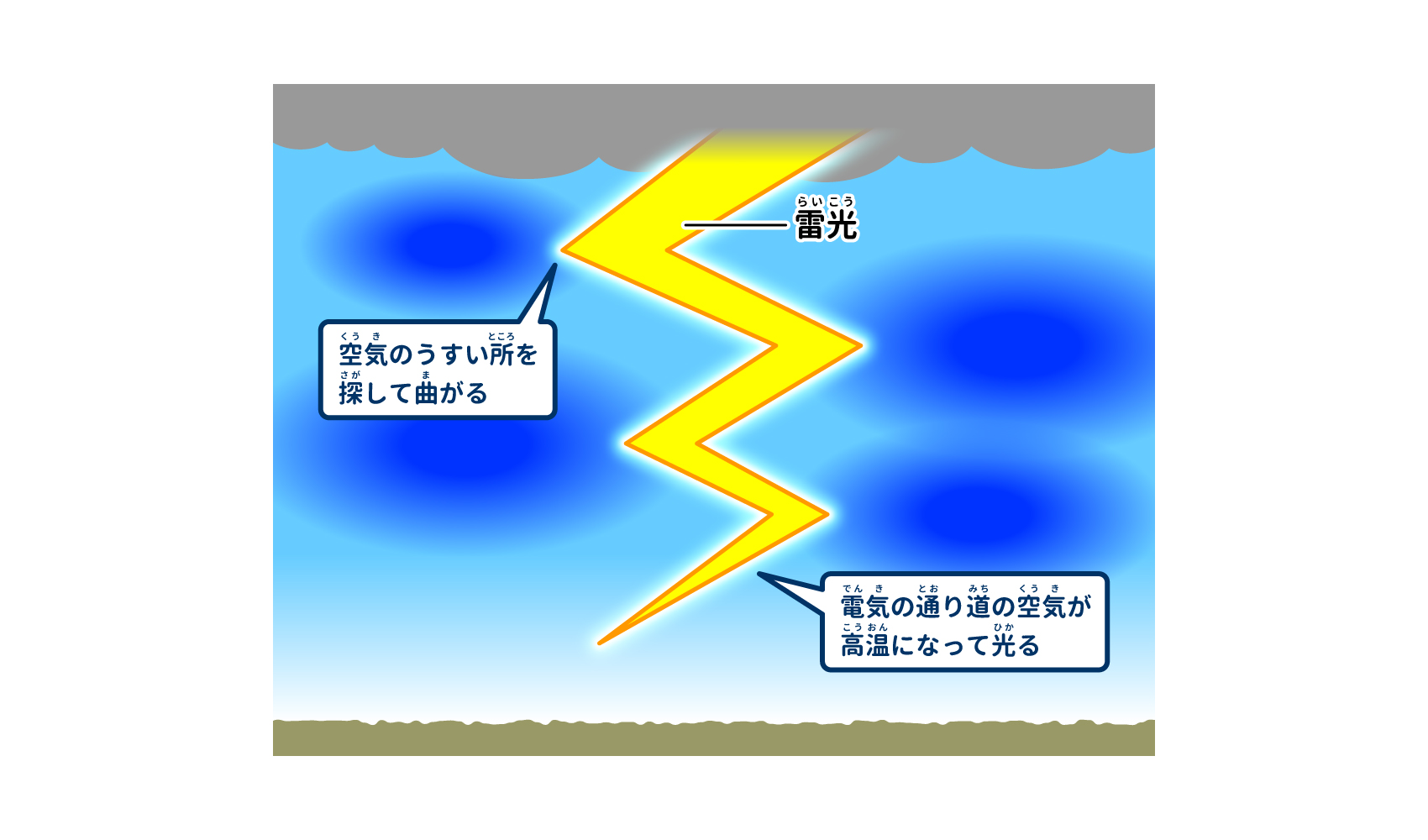
Answer: This is because the path of electricity emitted from the clouds is hotter.
The word "thunder" can be divided into "lightning" or "thunderbolt," which is just a flash of light, "thunderclap," which is just a rumbling sound, and "thunderstorm," in which both light and sound are observed1). The thunderclap is a phenomenon that occurs when the air is shaken by the heat of electricity (see related article, "Why Does Thunder Rumble?) (Related article: "Why does thunder rumble?"). What is the mechanism by which lightning and thunderstorms are generated?
As is well known, lightning is really electricity (see related article, "How Does Lightning Strike?"). The lightning is a thunderstorm. When ice crystals collide with each other in a cumulonimbus cloud, static electricity is generated, and when electricity builds up to the limit of what can be kept in the cloud, it is discharged to the earth's surface. This phenomenon is called "electrical discharge.
The discharge is short, lasting only about 0.001 to 1 second, but it adds energy of 3,000 to 200,000 A (amperes) and 100 million V (volts), and the temperature of the air around the path of the electricity reaches about 30, 000°C2). 2) This is an extremely high temperature, about five times higher than the surface temperature of the sun. Most materials begin to glow a dull red at temperatures above 500°C, becoming brighter as the temperature increases, and changing from red to white and then to blue at temperatures above 1,300°C. In this way, the color and brightness change at high temperatures, and the same is true of air. The air around the discharge path at a temperature of about 30,000°C emits a dazzling blue-white light*.
You may not have many opportunities to observe lightning closely because it only shines for a brief moment, but if you look at videos and photos of lightning and electricity, you will see that the light travels from the clouds to the earth's surface in a zigzagging path. Why can't electricity travel in a straight line?
Electricity cannot normally travel through air. Therefore, lightning is forced to go through the air. At this time, the path of electricity is zigzagged as it repeatedly moves forward, stops, and then moves forward again, stopping where it can pass through the air as easily as possible.
Lightning can easily pass through areas with thin air and high humidity3). Light air" means that there are few nitrogen and oxygen molecules, which interfere with the passage of electricity. If the humidity is high, the calcium and metallic substances in the water make it easier for electricity to pass through. At first glance, zigzagging may seem like a roundabout way, but in fact it is the fastest path to the earth's surface.
Raiden may appear orange, red, or purple. This is because the light is scattered by dust and water in the air before reaching the human eye. If the amount of scattering is high, the light appears reddish, and if there is little scattering, it appears white or blue.
Article published: April 2022
reference data
(1) Franklin Japan, "Lightning Knowledge," What is Lightning?
https://www.franklinjapan.jp/raiburari/knowledge/lightning/37/
(2) Otowa Electric Industry, "Technical Information: Key Points of Lightning Protection Lightning Discharge Phenomena": https://www.otowadenki.co.jp/basic4/
(3) Takako Sugai, "Everyone Wants to Know! How Weather Works: From Familiar Weather to Abnormal Weather around the World" May 2021. Mates Publishing Co.
Supervisor: Mitsuharu Oyama

Born in Tokyo in 1957. Completed a master's degree at Tokyo Institute of Technology. After working as a physics teacher at a high school, a chief instructor at Chiba Prefectural Board of Education, and principal of Chiba Prefectural Chousei High School, he is currently a professor at Shumei University School Teachers' College, where he teaches lectures and exercises on teaching methods for "Science and Mathematics Exploration" and "Integrated Learning Time". He has appeared in many science experiment classes and TV experiment programs. He is also a project advisor for the Chiba City Science Museum, an executive director of the Japanese Society of Physics Education, a member of the Japanese Society for Science Education and the Japanese Society for Science Education, and a member of the editorial board of the monthly magazine "Science Education.